
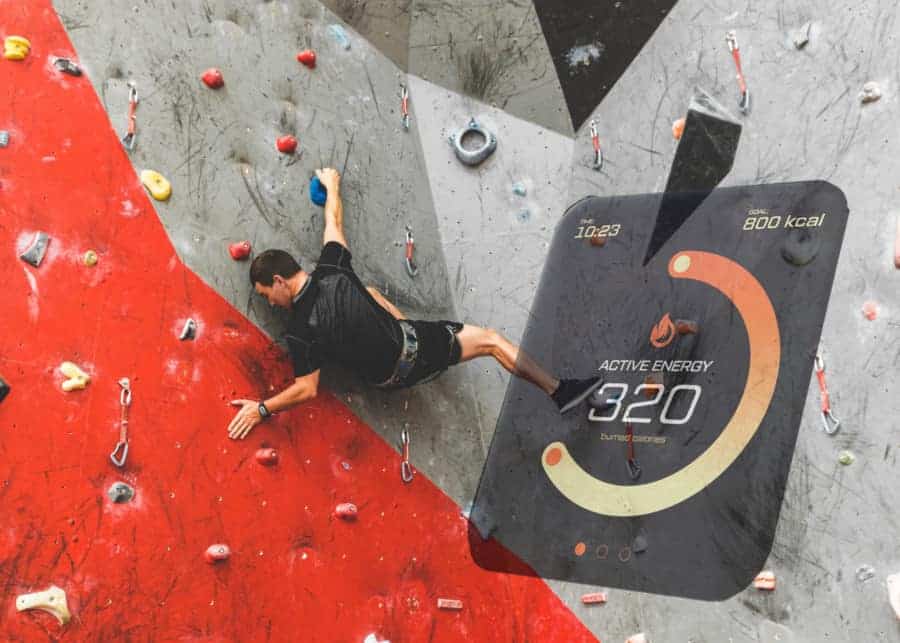
Climbing is a solid full-body workout, and if you’re chasing weight loss or just curious after a good session, you’ve probably wondered about the calories burned climbing for an hour on the wall. The short answer is that it depends on you, but there are a few real ways to get a number that’s close.
For a session that’s moderately hard, here’s roughly what the average person burns per hour, based on MET value.
- A 100lbs person burns an average of 340 calories per hour
- A 150lbs person burns an average of 510 calories per hour
- A 200lbs person burns an average of 680 calories per hour
Those numbers move around a lot, though. They shift based on how hard you’re climbing, your age, gender at birth, heart rate, and VO2 max. If you want the bigger picture on why climbing torches calories in the first place, we broke that down in 22 health benefits of climbing.
Since “average” usually doesn’t describe anyone very well, I dug into how calories burned actually get measured so I could get a real sense of my own numbers each session. What I learned is that most calorie counts are overestimated when they come from a smart watch or activity tracker, and that professionals lean on your heart rate and VO2 max to get closer to the truth.
So I pulled all of that research into one place so you can measure your own calories burned climbing and get a more accurate idea of what a session actually costs you.
Using Your Smart Watch
A lot of people grab a smart watch when they start counting calories to lose weight. I did too. The problem is that smart watches aren’t the most accurate way to measure calories, and they tend to overestimate what you burned.
In an article published by Harvard, smart watches were found to help improve the health of the person wearing one. But in a study by Stanford, researchers found that while smart watches read heart rate fairly well, the calorie counts are usually overestimated.
According to my watch, during my climbing session earlier today, I burned 512 active calories and 620 total calories.
Even so, I’m not tossing my smart watch, and I’d still tell people to climb with one. That’s a different story.
The watch is still handy for tracking your heart rate, which you’ll need for some of the calculations further down.
Using MET Value To Estimate Calories Burned Climbing
MET value, or the Metabolic Equivalent of Task value, is a number tied to different activities that helps you work out how many calories each one costs. For climbing, there are three main numbers, which are basically easy, moderate, and hard.
- 8: rock or mountain climbing
- 7.5: rock climbing, ascending rock, high difficulty
- 5.8: rock climbing, ascending or traversing rock, low-to-moderate difficulty
Once you’ve got the MET value, you multiply it by your weight in kilograms. That gives you the average calories burned for that activity.
Example: someone who weighs 45KG and climbed hard for one hour would use the following calculation: 45×8=360 calories burned.
| 100lbs (45.35 KG) | 150lbs (68.03 KG) | 200lbs (90.71 KG) | |
| Easy | 263 Calories Per Hour | 394 Calories Per Hour | 526 Calories Per Hour |
| Moderate | 340 Calories Per Hour | 510 Calories Per Hour | 680 Calories Per Hour |
| Hard | 362 Calories Per Hour | 544 Calories Per Hour | 725 Calories Per Hour |
There aren’t clear cut lines for what counts as easy, moderate, or hard. My guess is a relaxed session under my redpoint, mostly on slabs where I can climb for what feels like forever, sits on the easy end. An overhung project I’m barely hanging onto and maybe can’t finish is probably the hard end.
At the time of writing this, I weigh 146lbs (66.2245 KG), so the math looks like this:
- For climbing sessions that are hard, 66.2*8 = 529 Calories per hour
- For climbing sessions that are moderate, 66.2*7.5 = 496 Calories per hour
- For climbing sessions that are easy, 66.2*8 = 383.96 Calories per hour
When I first found this, it felt like the golden bullet. I was pumped to have an easy way to measure my calories burned. But after a lot more digging, I learned that as convenient as it is, it isn’t all that accurate.
A Problem with MET Value Calculations
A big issue with MET value is that it doesn’t factor in your gender, which has a real effect on how many calories you burn. It also skips your height and age.
Luckily, there are online calculators that take those numbers into account so you can get a more accurate idea of the calories you burn while climbing, and you can find one here.
When I plugged my info into that calculator, my estimate for a hard session dropped from 529 calories to 495. So a pretty big swing.
Another reason people don’t love MET value for climbing is that most of the studies behind those numbers used elite climbers, so traversing for them is like walking. For an average person, that same traversing might sit closer to the energy cost of jogging or running.
Using Your Heart Rate To Measure Calories
Some pro climbers like Adam Ondra and Alex Honnold have tracked their heart rate on hard routes and found that it actually drops once they get on the wall. That’s unlikely to happen for the average person, though.
I’m probably not the average climber either, but for what it’s worth, my heart rate climbs a lot while I’m on the wall. Especially when I’m bouldering. It’s one of the reasons climbing doubles as decent cardio, which we get into in is climbing and bouldering good for cardio.
And yes, your mental game plays into an elevated heart rate, so if your head’s solid, your heart rate might not spike as much.
Heart rate is a decent read on how hard you’re working, but on its own it’s not a great gauge of calories burned, because it leans heavily on the cardio health of the person.
For example, an elite athlete has a lower resting heart rate than an average person, so a 60 beat jump might only be 110 beats per minute compared to 140 beats per minute, but that doesn’t mean the elite athlete isn’t burning just as many calories.
Even so, studies have shown that pairing heart rate with gender, weight, and age measures calories more accurately than a plain smart watch. The nice part is that this uses your session’s average heart rate, so if you work harder one day than another, the number reflects it.
Male: ((-55.0969 + (0.6309 x HR) + (0.1988 x W) + (0.2017 x A))/4.184) x 60 x T
Female: ((-20.4022 + (0.4472 x HR) – (0.1263 x W) + (0.074 x A))/4.184) x 60 x T
- HR = Heart rate (in beats/minute)
- W = Weight (in kilograms)
- A = Age (in years)
- T = Exercise duration time (in hours)
For me, my average heart rate for today’s 1 hour session at the bouldering gym was 140, so the calculation would be ((-20.4022 + (0.4472 x 140) – (0.1263 x 66.2) + (0.074 x 26))/4.184) x 60 x 1
Copy and paste that into Google and I get: 512.93 calories burned for that session.
A few people have built online calculators so you can just enter your info and get the result with no copy and paste. The one I liked best while researching this article is here.
One word of caution. The calculation may assume the average resting heart rate for your age. The average resting heart rate for a 26 year old like me is 71 to 74, but mine has averaged 56 over the last month, which is a lot lower…
As you’d expect, tracking your heart rate accurately during a session is key for this one. Luckily, plenty of smart watches like the Apple Watch (what I use) and Fitbit have been proven to get a fairly accurate heart rate read. A chest strap is another option, and it usually reads more accurately than a watch on your wrist.
If you’re on an Apple Watch, I’d grab the Redpoint app. It’s built for climbing, and along with heart rate it tracks how many routes you climb, the distance you climb, and the grade of each route so you can track progress.
Using Your VO2 Max To Measure Calories
Probably the most accurate way to measure calories burned during a session is a calculation that factors in your VO2 max along with your heart rate.
VO2 max is the volume of oxygen you can use while working at your max capacity. In other words, it’s a read on your aerobic health and a baseline for how hard you’re working during exercise.
- V = Volume
- 02 = Oxygen
- Max = Max
By combining your aerobic health (VO2 max) with your heart rate, gender at birth, age, and weight, you get calories burned during your session that’s tuned to your body and how it works.
Once you have your VO2 max, you can use this to work out how many calories you burned during your last session:
Male: ((-95.7735 + (0.634 x HR) + (0.404 x VO2max) + (0.394 x W) + (0.271 x A))/4.184) x 60 x T
Female: ((-59.3954 + (0.45 x HR) + (0.380 x VO2max) + (0.103 x W) + (0.274 x A))/4.184) x 60 x T
You can run the math yourself, or use this online calculator that I found really helpful.
As good as this sounds, measuring your VO2 max accurately needs special equipment that clinics charge a hefty price for. On top of that, your VO2 max improves with training, so whatever it is now might shift in a couple of months.
The Apple Watch tries to estimate your VO2 max with an algorithm based on your heart rate and movement, but since it doesn’t actually measure your oxygen, it can’t give you an accurate VO2 max.
I haven’t paid a professional to measure mine, so the following uses the VO2 max my Apple Watch gave me, which, as I said, isn’t the most accurate. Still, I figured it’d help to see how I used this to measure my average calories burned during this morning’s bouldering session.
- V02Max = 34.5
- HR = 140
- W = 66.2
- A = 26
- T = 1
((-59.3954 + (0.45 x 140) + (0.380 x 34.5) + (0.103 x 66.2) + (0.274 x 26))/4.184) x 60 x 1 = 439.63
Conclusion
Part of why I shared my own numbers for each method was to show how much they vary. Here they are again:
- Smart Watch: 512 Active Calories and 620 Total Calories
- MET Value: 529 Calories
- MET Value + Details: 495 Calories
- Heart Rate + Details: 512.93 Calories
- V02Max + Heart Rate + Details: 439.63
As you can see, they’re all different, though the heart rate calculation lands really close to the Apple Watch active calories.
So which method should you use? Great question. There’s solid science behind each one, so it’s tough to crown a single best. That said, I think the more you tell the calculation about yourself, the more accurate it’s likely to be, so I lean toward the VO2 max calculation that includes your heart rate, age, weight, and gender at birth. The catch is that getting an accurate VO2 max puts that one out of reach for most people.
So for everyday use, I’d go with the MET value calculation that includes your height, age, and weight. It’s easy to get to, you don’t need any equipment beyond a scale, and that makes it the most accessible way to measure your calories burned climbing.
And if calories are your reason for climbing, keep in mind the wall builds more than it burns. Climbing puts on real strength too, which we get into in can climbing build muscle and replace weight training.
One more thing that helps, no matter which number you trust: climbing consistently and with a bit of structure. If you want that in your inbox, our free newsletter sends you one short climbing drill a week that takes about 15 minutes. You can grab the weekly drills here.
Frequently asked questions
How many calories do you burn from an hour of climbing?
For a moderately hard session, MET value puts the average person somewhere around 340 to 680 calories per hour depending on body weight. A 100lbs climber burns roughly 340, a 150lbs climber roughly 510, and a 200lbs climber roughly 680. Your real number shifts with intensity, age, gender at birth, and heart rate.
Are calories burned climbing accurate on a smart watch?
Not really. Research out of Stanford found that fitness trackers read heart rate fairly well but tend to overestimate calories burned. A watch is still useful for tracking heart rate, which you can feed into a more accurate calorie calculation.
What’s the most accurate way to measure calories burned climbing?
The most accurate method combines your VO2 max with your heart rate, age, weight, and gender at birth. The downside is that an accurate VO2 max needs lab equipment most people can’t easily get. For everyday use, the MET value calculation that includes your height, age, and weight is the most accessible option.
Does climbing burn more calories than running?
It can be close for the average climber. Because most MET studies used elite climbers, traversing for a regular person may cost energy closer to jogging or running than the MET numbers suggest. Your effort level, not the label on the activity, is what drives the burn.
More About Training for Climbing:
- How To Climb More Often Without Getting Injured | Tried And Tested Methods For Recovery
- Lower Body Mobility And Flexibility Challenge
- Neglected Techniques Necessary For V4-V5 Progression
- 17 Footwork Drills For Climbing
- Mental Training For Climbing
- How Often And Hard Should You Climb To Get Gains?
- When Should You Start Hangboarding For Boulder’s
- Is Bouldering When Sore Bad?
- The Top 22 Climbing Techniques And Skills And How To Do Them
- 23 Tips For Climbing Slabs
- When To Flag In Climbing And How-To-Do It (With Videos)
- How To Learn Climbing Technique For Beginners
- What Should You Record In A Climbing Journal?
- Climbing Endurance: Muscle, Skin And Mental Training
- How To Deal With Fear Of Falling
- How Many Days Should You Climb Per Week?
- 5-10 Minute Warm-Up For Climbing
- What Is A Dyno And How To Do It
- What Is A Gaston In Climbing? Powerful Moves For Beginners
- Can Foam Rolling Improve Rock Climbing Performance?
- 7 Things Climbers Should Do On Rest Days For Better Performance
- When Do You Need A Rest Day?
- How To Climb Your Best – Pros And Cons Of Rest Days
- Static Vs Dynamic Climbing Movement: Pros And Cons
- 5 Habits For Healthy Climbing That You Haven’t Thought Of
- 5 Things To Improve Climbing Performance And Sustainability
- 10 Minute Workout Routines For Post Climbing Sessions
- How To Use Climbing Holds: Techniques For Improved Climbing
- A Guide For Climbers: Bouldering Drills 101
- 12 Easy Workouts To Increase Hand And Grip Strength For Climbers
- What Are Undercling Climbing Holds And Why Climbers Love/Hate Them
- What Is A Crimp In Rock Climbing And How To Train For Them
- 7 Common Mistakes in Rock Climbing For Beginners
More Trending Topics Like This:
- What Happened During The Men’s 2021 Climbing Olympics?
- Who Are The Climbers Competing In The Tokyo Olympics 2021?
- Is Climbing A Sport?
- How Many Calories Do You Burn From Climbing?
- 17 Reasons Why Bouldering Is So Popular
- The Evolution Of Climbing Belay Devices
- 23 Storage Ideas For Your Climbing Gear
- Why Is Climbing Such A Mental Sport?
- The Best Way To Take Climbing Chalk Through Airport Security
- Is Bouldering That Hard? Yea, It’s Hard – This Is Why
- Is Climbing Considered A Sport
- Is Climbing And Bouldering Good For Cardio?
- Top 10 Home Climbing Gym Designs
- 9 Signs You’re Seriously Addicted To Climbing
- Why Do People Like Climbing?
- What You Need To Know About Climbing In The 2021 Tokyo Olympics
- Can Climbing Build Abs And Make You Look Chiseled
- How To Introduce Your Friends To Climbing (15 Steps)
- Tips For Handling Your Period While Climbing
- Is Bouldering Outdoors Harder Than Indoors?
- Can You Go Rock Climbing Outdoors During The Covid 19 Pandemic?
- 7 Reasons To Wear Socks With Climbing Shoes
- What Is Dabbing? | Climbing Vocabulary And Culture
- Bouldering Vs Climbing: Training, Skills, Strength, Grades
- Indoor Vs Outdoor Climbing: A Thorough Comparision
- 22 Health Benefits Of Climbing – Backed By Research
- Bouldering And Sports Climbing Glossary: Lingo And Language
- Quick Tips For Getting Back Into Climbing After A Long Break
- 10 Legit Reasons You Should Not Rock Climb
- Can Climbing Build Muscle And Replace Weight Training?
- Do You Wear Socks With Rock Climbing Shoes?
- Is Bouldering Dangerous?
- What Should You Record In A Climbing Journal?
- How Are Climbing Routes Graded?
- First Time At The Bouldering Gym – What You Should Know
- 7 Common Mistakes In Rock Climbing For Beginners
- How Do Alpinists Get Down?