This post contains affiliate links. If you buy through them, I may earn a commission at no extra cost to you.
I don’t own a Petzl Connect Adjust, but every time a friend brings one to the crag and I get to borrow it for anchor cleanup, I’m reminded why it’s worth the investment. The first time I used one, I was complaining about sketchy footing at an anchor where my fixed-length lanyard left me stretched out or scrunched up. My friend handed me his Connect Adjust, showed me how to adjust it in under five minutes, and suddenly cleaning that anchor felt comfortable instead of just safe. When you’re doing something as important (and potentially dangerous) as cleaning anchors, that difference matters.
If you’re trying to decide which Petzl Connect Adjust is right for you, the choice comes down to one question: do you need the full version with the energy absorber, or will the lighter version without it work for your climbing?
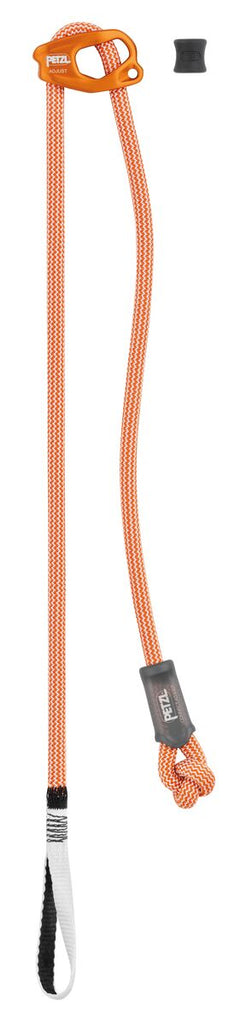
Petzl Connect Adjust (with energy absorber)

This is the full-featured version. It has an integrated energy absorber that deploys in a fall, which makes it suitable for work positioning or situations where you might take a short fall while clipped to an anchor. The energy absorber limits the force on your body and the anchor if you slip.
Who it’s for: Climbers who use their lanyard for work positioning (like aid climbing or multi-pitch where you’re hanging at anchors for extended periods), or anyone who wants the added security of fall protection built into their lanyard. If you’re cleaning anchors on steep terrain where a slip is possible, the energy absorber gives you a margin of safety.
Who it’s not for: Climbers who only use a lanyard for direct connection to anchors in low-risk situations (like topping out on a slab or clipping in at a sport anchor where you’re always weighted on the rope). The extra weight and bulk might not be worth it if you never work-position or hang on your lanyard.
The adjustable length (40 to 200 cm) means you can dial in your distance from the anchor no matter where your feet end up. Bad footing? Shorten it. Need to reach across to clean the second bolt? Lengthen it. The adjustment is simple: pull the rope through the cam to lengthen, squeeze the cam to shorten.
Petzl Connect Adjust without energy absorber
This version strips out the energy absorber to save weight and bulk. It’s purely for direct connection to anchors, not for work positioning where you might fall. The length adjustment works the same way (40 to 200 cm), but without the fall-arrest function.
Who it’s for: Sport climbers and single-pitch climbers who use a lanyard strictly for clipping into anchors while cleaning or transitioning. If you’re always on belay and the lanyard is just there to keep you attached while you break down the anchor, this lighter version does the job.
Who it’s not for: Anyone doing aid climbing, work positioning, or any situation where you might weight the lanyard and take a fall. Without the energy absorber, a fall onto this lanyard would generate high forces on your body and the anchor.
How to choose
Ask yourself: will I ever hang on this lanyard in a position where I could fall? If yes, get the version with the energy absorber. If no (you’re only using it for direct anchor connection while on belay), the lighter version will work.
For most sport and single-pitch climbers, the version without the energy absorber is enough. You’re clipping in at the anchor, cleaning the draws, and lowering off. The lanyard keeps you attached, but you’re not work-positioning or taking falls on it.
For multi-pitch, trad, or aid climbers who spend time hanging at anchors or adjusting gear while clipped to the lanyard, the energy absorber is worth the extra weight. It’s not just about safety compliance, it’s about having a tool that works for how you actually climb.
What both versions get right
The adjustable length is the reason to choose a Connect Adjust over a fixed-length lanyard. Anchors vary. Footing varies. Being able to fine-tune your distance from the anchor on the fly makes cleaning safer and less awkward. I’ve been at anchors where a fixed lanyard would have left me stretched out on tiptoes or jammed up against the rock. The Connect Adjust solves that.
The rope construction is durable and easy to inspect. The cam mechanism is intuitive once you’ve used it a few times. It’s not the lightest lanyard option out there, but it’s reliable and it does what it’s supposed to do without fuss.
Limitations to know
Neither version is a replacement for a PAS or daisy chain in all situations. If you’re building anchors and need multiple attachment points or redundancy, you’ll still want a dedicated anchor system. The Connect Adjust is best as a single adjustable tether for cleaning or transitioning.
The adjustment takes two hands. If you’re in a position where you need to adjust length while hanging, it’s doable but not as fast as some other systems. Practice the adjustment on the ground before you’re at an anchor.
Confirm the return policy and sizing with the shop before you buy. Some climbers prefer a shorter maximum length for sport climbing, others want the full range for multi-pitch transitions.
Ready to add adjustable length to your anchor cleanup? Check current price at Outdoor Gear Exchange and decide which version fits how you climb.