A friend of mine was complaining about how boring it is to slog through the weight room, so she asked me if I thought climbing was good for building muscle. What she was really asking is the question this whole article is about: can climbing build muscle and replace weight training? From my own time on the wall I know it builds muscle, but I wanted to see if the research backed it up too.
Climbing is a full-body workout and, like a lot of bodyweight training, it’s great for building muscle. The muscles climbing hits hardest are the abs, forearms, shoulders, and triceps. Most climbers notice gains within one to two weeks of getting on the wall. That said, plenty of experienced climbers still add weight training to build muscle faster.
Maybe you want to be more active, or maybe you’re bored at the regular gym and thinking about swapping it for a climbing gym. Either way, you’re probably wondering if climbing can stand in for your usual workout. This article walks through the main muscles climbing builds, whether you can drop the gym for the wall, and whether you should still keep some weight training in the mix. If you’re curious about the wider payoff, we’ve also rounded up the health benefits of climbing backed by research.
Can Climbing Build Muscle
You’ve probably seen some seriously toned climbers and wondered if climbing builds muscle on its own. Most advanced climbers pair the wall with strength training, so it’s hard to tell what’s from climbing and what’s from the lifting. The short version: climbing does build muscle, but it won’t give you a bodybuilder’s frame.
Research has shown that training with bodyweight (climbing is a bodyweight activity) clearly improves muscular endurance, but what about raw strength and body composition? Climbing is one reach and hold after another, over and over up the wall. All that reaching and pulling your own weight up builds muscular strength, muscular endurance, better body composition, and flexibility.
Like any bodyweight exercise, using a muscle again and again tones it and makes it stronger. If you’re constantly pulling your body up with your biceps, which happens a lot in climbing, your biceps are going to get stronger.
On the flip side, a lot of climbers have pointed out that there’s a ceiling on how much muscle you actually need for climbing, and past that point technique takes over. That’s why some climbers feel like the muscle-building phase only lasts a little while when you first start, and that you need weight training to keep the gains coming. If you want a sense of how quickly progress comes, this breakdown of how often and hard you should climb to get gains is a good next read.
What Muscles are Used in Climbing
Climbing is a full-body workout, and by the end of an hour of hard climbing you’ve probably used just about every part of your body. I could list every muscle and how it fires on the wall, but you don’t really care about some hairline muscle on the side of your neck compared to the big groups climbing leans on. Here are the muscles climbing works the most.
Upper Body
A lot of climbers think of climbing as an upper-body workout because so many upper-body muscles get worked. In general, guys tend to lean on their upper body more than women do, but both report their upper body getting stronger from climbing. Here are the main upper-body muscles climbing uses:
Deltoids
Location: The Deltoids are located at the front of your shoulders
The anterior deltoids do a ton of the work pulling your body up the wall, and they’re one of the muscles climbers rely on most. Because the back of the shoulder doesn’t get used nearly as often, climbers can end up with imbalances around the rotator cuff, which can lead to shoulder instability and injury. To keep that in check, climbers recommend posterior shoulder work to keep the rotator cuff healthy.
Biceps
Location: Biceps are the muscles on the front of your arm between your shoulder and elbow
No surprise here, pulling yourself up with your arms is a bicep-heavy job. Like most muscles on this list, your biceps work harder the steeper the climb, so if you want to build them up, get on some steep or overhanging walls.
Triceps
Location: Triceps are the muscles on the back of your arm between your shoulder and elbow
Just like your biceps, your triceps pull you up too. That’s probably why climbers are notoriously good at pull-ups, which are also a tricep-heavy move. If you don’t have a pull-up bar and want to build triceps at home, tuck your elbows in at your sides during pushups to shift more of the load onto them.
Forearms
Location: The forearms are the muscles between your elbow and your wrist
Studies on climbing and health keep noting stronger forearms, and they tie it back to how much grip climbing demands. Climb regularly and your grip strength climbs with it, and your forearms are a big part of that. This is also a pretty easy muscle to keep working on.
If you want to build up your grip strength, check out this article (12 Grip Training Exercises: A Guide for Climbers to Increase Hand Strength)
Pecs (Pectoralis Major/Minor)
Location: The Pec muscles are on your upper chest muscles
Your chest muscles are another big player in pulling down. Climbers often notice their pecs getting more defined after they’ve been climbing a while. And if you don’t train the back of your shoulders, your chest muscles tighten up to protect them, which means they get worked even more. The problem is that tight chest usually shows up as the dreaded climber’s hunch, so it’s important to give your back muscles some extra attention.
Core
Location: The Core muscles are located between your chest and hips
Your core is a huge engine for climbing. Without it you couldn’t make the moves climbing asks for, and you really feel that on an overhanging wall or once the climbs get harder. Here are the two main core muscles climbing uses:
Lats (Latissimus Dorsi)
Location: The lat muscles are the muscles located on the sides of your back that are the winged shape
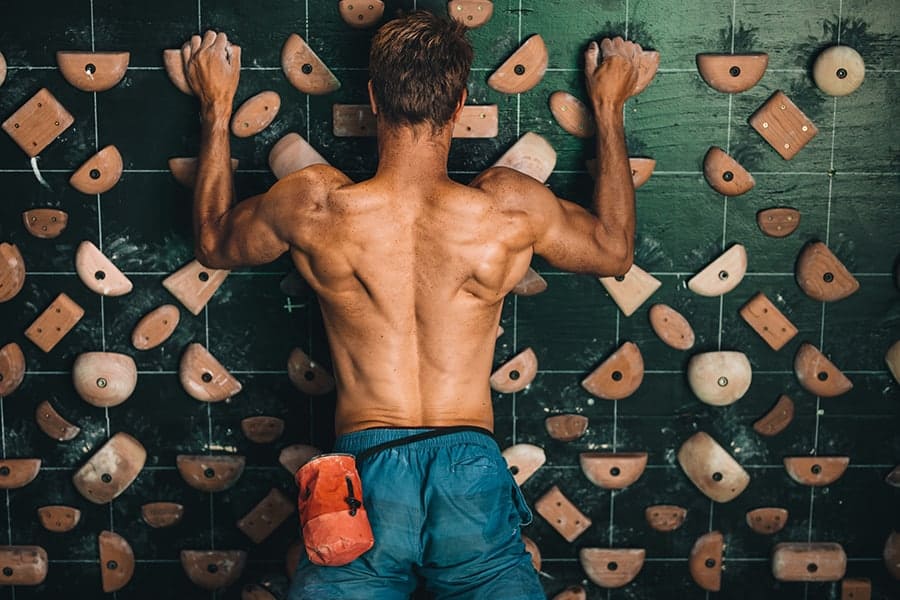
Your lats are what let you pull down. Every time you climb you’re pulling and building them, so it’s worth stretching and balancing all that pulling with a bit of pushing too. There’s a reason climbers love handstands.
Abdomen
Location: The Abdomens (abs) are located on your front side between your chest and hips
Right behind your lats, your abs are one of the most-used muscles in climbing. As part of your core, they hold your body close to the wall and let you move your limbs and stay balanced through each move. Climbing coaches usually add ab-specific work to a climber’s routine for exactly this reason. The stronger your abs, the better you climb, and it goes both ways: the more you climb, the stronger your core gets. If you’re chasing that look, we get into it more in can climbing build abs and make you look chiseled.
Lower Body
Spectators tend to underrate it, but your lower body does a huge amount of the work getting you up the wall. Women generally use their legs more than men do, but both notice their legs getting stronger from climbing. Here are the main lower-body muscles climbing uses:
Glutes
Location: The Glutes are the muscles in your buttocks
Your glutes are the bridge to your legs, and they get used more than climbers realize. Used well, they help you build momentum, stay balanced, and reach. Engaging your glutes, for instance, is what pulls your hips in close to the wall, so they’re a major climbing muscle. The catch is that a lot of beginners never really switch them on, so their lower half turns into dead weight instead of a muscle group that helps push them up the wall.
Thighs
Location: The thighs are the muscles between your hip joint and knees
Climbing gets called an upper-body sport a lot, but your thighs can end up being some of the hardest-working muscles on the wall. Climb with good technique and your thighs get a real workout. Even with sloppy technique, it takes a lot of thigh muscle to pull your feet up to the next foothold and push up so your hands can reach the next hold. Women are generally more likely to push up with their legs, while men tend to lean on their arms to pull.
Calves
Location: The calves are the muscles between your knee and ankle
Every time you set your toe on a hold and push up, you’re using your calves. You fire them just by standing up on your toes, which is a key move for getting up the wall, so that calf contraction happens constantly. A lot of climbers notice more calf definition after a session, and some say their calves burn after a hard climb from how much they get worked.
Can Climbing Build Muscle and Replace Weight Training at the Gym
One of the big reasons people get into climbing is that they don’t want to grind through a traditional gym workout but they do want to be more active. Depending on your goals, climbing can replace the gym. It’s a great cardio workout, and stacked against a lot of what you’d do in a gym, it holds up well as a swap. If cardio is your main worry, we compare it head to head in is climbing and bouldering good for cardio. But if you want big muscles or to bench and squat twice your bodyweight, you’ll still need to lift.
Should You Supplement Climbing with Weight Training
As climbers keep training or start to plateau, they often wonder if adding weighted gym work is worth it. If you want to get stronger and build muscle faster, then yes, supplementing climbing with weight training is a solid way to do it. It matters even more because you should be taking one or two days off climbing each week anyway. A common setup is climbing with climbing drills three times a week and weight training twice a week.
If you want a guide for bouldering drills to add to your routine, check out this post (A Guide For Climbers: Bouldering Drills 101)
If you’d rather have that climbing-and-strength split laid out for you instead of piecing it together yourself, the Grip & Grind app builds a structured plan around your climbing so you know what to do on your training days.
Climbing is a full-body workout, but each problem or route leans on different muscles. Like any training, balancing your muscles across your workouts matters. Since climbing naturally builds the front of your shoulders, put some extra focus on the back of your shoulders to avoid imbalances. Same idea for everything else: if you had a tricep-heavy climbing week, hit your biceps, and so on.
Want to keep getting better without overthinking your training week? Our free newsletter sends you one short climbing drill at a time, about 15 minutes each. Level up your climbing with 15 minutes of training and grab the weekly drills for free.
Conclusion
Climbing is a full-body workout that hits your upper body, core, and lower body. Some muscles get neglected more than others, so it’s worth paying attention to your body and adding in extra work to balance them out, especially the back of your shoulders. Focusing on that balance is a big part of preventing the instability injuries that come from lopsided muscles.
Frequently asked questions
Can climbing build muscle and replace weight training on its own?
Climbing builds real muscle and tones you up, especially in your abs, forearms, shoulders, and triceps, but it won’t give you a lifter’s body. There’s a ceiling on how much muscle climbing actually needs, and past that point technique takes over. If your goal is to keep building size and strength, most climbers add weight training on top of climbing rather than relying on the wall alone.
How fast do you see muscle gains from climbing?
Most climbers notice gains within one to two weeks of starting. A lot of that early progress comes fast when you’re new, and then it levels off, which is when many climbers add weight training to keep building muscle.
Which muscles does climbing work the most?
The muscles climbing hits hardest are the abs, forearms, shoulders, and triceps, but it’s a full-body workout. Your lats, biceps, pecs, glutes, thighs, and calves all get worked too, which is why an hour of hard climbing leaves so much of your body tired.
Can climbing replace going to the gym?
It depends on your goals. Climbing is a great cardio workout and can absolutely replace a general gym routine if you just want to stay active and fit. But if you want big muscles or to bench and squat twice your bodyweight, you’ll still want to lift weights alongside climbing.
How should you combine climbing and weight training?
A common setup is climbing with drills three times a week and weight training twice a week, which leaves you the one or two rest days you should be taking anyway. Balance your muscles across the week, and since climbing naturally builds the front of your shoulders, add extra work for the back of your shoulders to avoid imbalances.
More Trending Topics Like This:
- What Happened During The Men’s 2021 Climbing Olympics?
- Who Are The Climbers Competing In The Tokyo Olympics 2021?
- Is Climbing A Sport?
- How Many Calories Do You Burn From Climbing?
- 17 Reasons Why Bouldering Is So Popular
- The Evolution Of Climbing Belay Devices
- 23 Storage Ideas For Your Climbing Gear
- Why Is Climbing Such A Mental Sport?
- The Best Way To Take Climbing Chalk Through Airport Security
- Is Bouldering That Hard? Yea, It’s Hard – This Is Why
- Is Climbing Considered A Sport
- Is Climbing And Bouldering Good For Cardio?
- Top 10 Home Climbing Gym Designs
- 9 Signs You’re Seriously Addicted To Climbing
- Why Do People Like Climbing?
- What You Need To Know About Climbing In The 2021 Tokyo Olympics
- Can Climbing Build Abs And Make You Look Chiseled
- How To Introduce Your Friends To Climbing (15 Steps)
- Tips For Handling Your Period While Climbing
- Is Bouldering Outdoors Harder Than Indoors?
- Can You Go Rock Climbing Outdoors During The Covid 19 Pandemic?
- 7 Reasons To Wear Socks With Climbing Shoes
- What Is Dabbing? | Climbing Vocabulary And Culture
- Bouldering Vs Climbing: Training, Skills, Strength, Grades
- Indoor Vs Outdoor Climbing: A Thorough Comparision
- 22 Health Benefits Of Climbing – Backed By Research
- Bouldering And Sports Climbing Glossary: Lingo And Language
- Quick Tips For Getting Back Into Climbing After A Long Break
- 10 Legit Reasons You Should Not Rock Climb
- Can Climbing Build Muscle And Replace Weight Training?
- Do You Wear Socks With Rock Climbing Shoes?
- Is Bouldering Dangerous?
- What Should You Record In A Climbing Journal?
- How Are Climbing Routes Graded?
- First Time At The Bouldering Gym – What You Should Know
- 7 Common Mistakes In Rock Climbing For Beginners
- How Do Alpinists Get Down?
More About Training for Climbing:
- How To Climb More Often Without Getting Injured | Tried And Tested Methods For Recovery
- Lower Body Mobility And Flexibility Challenge
- Neglected Techniques Necessary For V4-V5 Progression
- 17 Footwork Drills For Climbing
- Mental Training For Climbing
- How Often And Hard Should You Climb To Get Gains?
- When Should You Start Hangboarding For Boulder’s
- Is Bouldering When Sore Bad?
- The Top 22 Climbing Techniques And Skills And How To Do Them
- 23 Tips For Climbing Slabs
- When To Flag In Climbing And How-To-Do It (With Videos)
- How To Learn Climbing Technique For Beginners
- What Should You Record In A Climbing Journal?
- Climbing Endurance: Muscle, Skin And Mental Training
- How To Deal With Fear Of Falling
- How Many Days Should You Climb Per Week?
- 5-10 Minute Warm-Up For Climbing
- What Is A Dyno And How To Do It
- What Is A Gaston In Climbing? Powerful Moves For Beginners
- Can Foam Rolling Improve Rock Climbing Performance?
- 7 Things Climbers Should Do On Rest Days For Better Performance
- When Do You Need A Rest Day?
- How To Climb Your Best – Pros And Cons Of Rest Days
- Static Vs Dynamic Climbing Movement: Pros And Cons
- 5 Habits For Healthy Climbing That You Haven’t Thought Of
- 5 Things To Improve Climbing Performance And Sustainability
- 10 Minute Workout Routines For Post Climbing Sessions
- How To Use Climbing Holds: Techniques For Improved Climbing
- A Guide For Climbers: Bouldering Drills 101
- 12 Easy Workouts To Increase Hand And Grip Strength For Climbers
- What Are Undercling Climbing Holds And Why Climbers Love/Hate Them
- What Is A Crimp In Rock Climbing And How To Train For Them
- 7 Common Mistakes in Rock Climbing For Beginners