This post contains affiliate links. If you buy through them, I may earn a commission at no extra cost to you.
You’re on a vertical face, mid-crux, and your foot is stuck on a hold that’s angled wrong for a normal stance. Your hip is pointing away from the wall, your arm is straightening out, and you can feel the pump building before you’ve even moved. That’s usually the moment a drop knee would save you, if you knew how to find it.
Drop knee was the first technique that really opened up the next grade for me. I felt like I suddenly had more control and leverage than I should’ve had, without getting any stronger. I noticed the difference on day one of actually using it on routes instead of just knowing what it was. The hard part wasn’t the move itself, it was figuring out which way to twist my hips. At first I’d just repeat to myself mid-climb: “whatever hand I’m moving, tap that hip to the wall.” It took forcing drop knees on routes where I didn’t strictly need them, plus some drills, before it started feeling automatic instead of forced.
What a drop knee actually does in rock climbing
A drop knee (also called an Egyptian) rotates your hip and knee inward toward the wall on the same side as your reaching hand. Instead of facing the wall square, you turn your lower body so your inside knee points down and in, and your foot twists on the hold. That rotation brings your hip closer to the wall, which shortens the distance to the next hold and keeps your weight stacked over your foot instead of hanging off your arms.
The payoff is leverage, not strength. You’re using your hip and leg to hold position so your arms can relax and your reaching hand can actually extend. Climbers who skip this and try to muscle through the same move usually end up barn-dooring, where the whole body swings open away from the wall because there’s nothing keeping the hips in. If that swinging-open feeling sounds familiar, it’s worth reading up on why you barn door in climbing, because drop knees are one of the main fixes.
How to drop knee on a climb, step by step
- Spot the foothold you’re already on or about to step onto, and check that it can take a twisted foot position (not every hold works for this).
- Turn your foot so the outside edge of your shoe is on the hold, toes pointing roughly toward the wall or slightly past it.
- Rotate your knee down and in toward the wall, which naturally pulls your hip in with it.
- Reach with the hand on the same side as the dropped knee. The rotation should bring that hand noticeably closer to the next hold.
- Keep your other foot active. It’s doing real work too, usually pushing or smearing to help stack your weight over the dropped-knee side.
If you’ve never drilled this on purpose, start on an easy vertical wall where you can hold the position without panicking about falling. Set up the drop knee, pause, and feel where your weight lands. That pause is where most people first notice their arms can actually relax.
Why your shoe matters more than you’d think
Here’s the part nobody tells you when they’re explaining drop knee mechanics: the move lives or dies on that outside-edge foot twist. If your shoe is stiff through the forefoot or the rubber doesn’t want to torque on a small lip, you’ll fight the hold instead of settling into it. A soft, down-turned shoe that can actually flex and rotate on an edge makes the whole setup click faster.
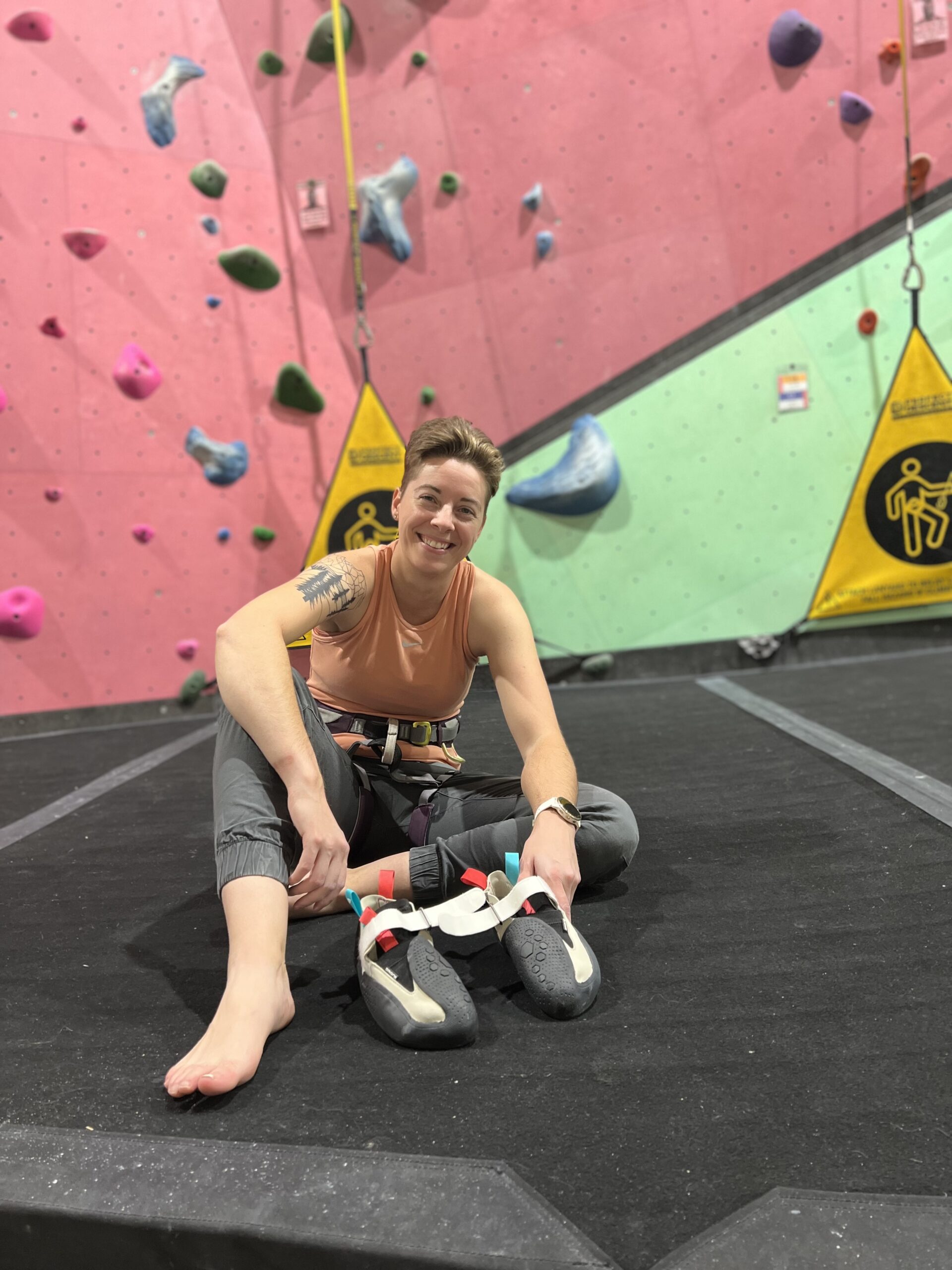
This is the shoe climbers in forums and gym threads keep bringing up when the topic turns to technical footwork and drop knees: the La Sportiva Katana Lace. It’s not a specialty shoe built just for this move, it’s a do-it-all technical shoe, but the soft forefoot and precise edge are exactly what a drop knee asks of your foot. That’s based on what climbers are actually saying about it, not a lab test.
Confirm sizing and return policy with the shop before you buy. Climbing shoe fit runs tight and personal, and what works for the climber in the forum thread might not work for your foot.
Mistakes that keep the drop knee from working
The biggest one is twisting the hip but not the foot. If your foot stays flat and only your hip tries to rotate, you lose the leverage and your knee just hangs there doing nothing useful. The foot has to turn first, the hip follows.
The second common mistake is doing the drop knee on the wrong side. It sounds obvious once you see it named, but under pressure a lot of climbers drop the knee on the same side as the hand that’s staying put, instead of the hand that’s reaching. That’s the exact mix-up I had to talk myself through early on, repeating “whatever hand I’m moving, tap that hip to the wall” until it stopped being a decision.
A third issue is bailing out of the position too early. The drop knee only pays off if you hold it long enough to actually make the reach. Rotating in and then standing back up before you’ve grabbed the next hold wastes the whole setup.
Drills to make the drop knee feel automatic
Knowing the mechanics and having it show up on a real route under pump are two different skills. What worked for me was a “drop knee everything” approach: on easy climbs, warmups, even traverses, I’d force a drop knee into moves where I didn’t strictly need one. It feels silly at first, but it trains your body to recognize the setup without you consciously thinking about it.
A simple way to add this into your session: fold drop-knee reps into your warmup instead of treating them as a separate drill. Climb an easy route twice, once normally and once forcing a drop knee on every move where your hips would otherwise square to the wall. Our full climbing warmup routine has more on building movement patterns into the first few climbs of a session, which is exactly where habits like this stick.
If you want a deeper breakdown with more drills specifically for this move, our drop knee climbing guide goes further into progressions. Pairing it with work on heel height and general movement fluidity and rhythm helps the drop knee stop feeling like an isolated trick and start feeling like part of how you move.
Reading the route for a drop knee before you climb it
You can often spot a drop knee opportunity from the ground. Look for a move where the next hold is far out to one side and the current foothold is angled or has a slight lip you could twist a shoe onto. If a sequence looks like it’ll square your hips to the wall and stretch your arm straight, that’s usually a sign a drop knee would shorten the reach. Getting better at this kind of pre-read ties directly into how to read a climbing route, since spotting the hip position before you’re committed saves you from getting gripped mid-move.
It’s also worth checking if the move doubles as a rest. A well-set drop knee can take enough weight off your arms that you get a shake-out before the next hard section. If you’re hunting for places to recover on a route, that overlaps a lot with finding rests in climbing.
FAQ
What’s the difference between a drop knee and an Egyptian?
Nothing. They’re the same move, just different names depending on where you learned to climb. Both describe rotating the knee and hip in toward the wall on the side of your reaching hand.
Why does my drop knee hurt my knee?
Usually it’s because the foot didn’t twist enough before the knee rotated, so the knee is absorbing torque that should be happening at the ankle and foot. Check your foot angle first. If it still bothers your knee after fixing foot position, ease off the move on that joint and build up gradually rather than forcing it on steep terrain right away.
When should I use a drop knee instead of a regular high step?
Reach for a drop knee when the next hold is far to one side and a square stance would stretch your arm straight or swing your hips open. A regular high step works fine when the next move is more directly above you and you don’t need the extra hip rotation to close the distance.
Can beginners learn drop knees, or is it an advanced move?
Beginners can learn it. The mechanics aren’t complicated, it’s the timing and recognizing when to use it that takes reps. Practicing on easy routes where you’re not worried about falling is the fastest way to get comfortable with the position.
Does a drop knee work on overhangs too, not just vertical walls?
Yes, and it’s often more useful on overhangs since there’s less friction to rely on and your hips need to stay close to the wall to keep weight off your arms. The setup is the same, just expect to hold the position with a bit more core tension.