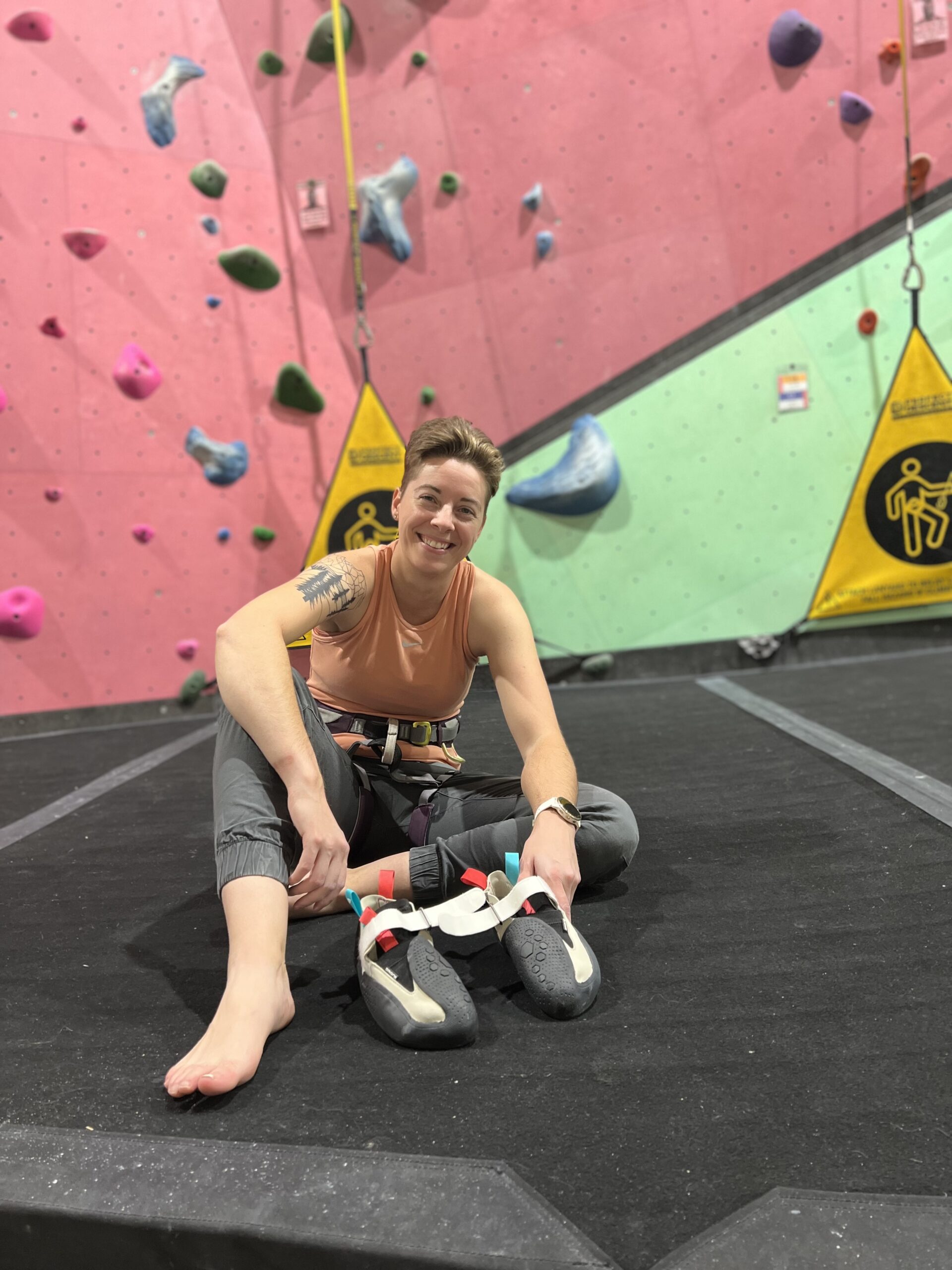
This is the start of my year-long project to go from average to climbing babe in 1 year, and this first update lays out the starting line: my first weigh-in, measurements, and benchmarks. I’m treating this like the experiment it is. Can a dedicated, on-the-wall climbing routine actually reshape my body, my fitness, and how I feel about myself? That’s what I’m here to find out, and I’m doing it without ever stepping into a traditional weight room. If you’re curious how that’s even possible, I dug into the why behind it in this post on transforming your climbing and body without traditional training.
In this monthly series you’ll get the highs and the lows, no filter. From the first weigh-ins and body measurements to how climbing shapes physical fitness and mental resilience, every update is an honest look at how this transformation actually unfolds.
What’s involved? Each month I’ll share:
- Physical updates: my current weight, body measurements, BMI, and body composition changes.
- Climbing progress: how my climbing is evolving and how it lines up with the physical changes.
- Personal reflections: the mental and emotional side of trying to transform through climbing alone.
Whether you’re here for the climbing, you’re into alternative fitness journeys, or you’re just curious whether someone can change their body without a conventional gym, I hope you find something that lights a fire. Let’s start with where I am right now and set the stage for what’s coming.
From average to climbing babe in 1 year: my first weigh-in and composition
When it comes to measuring body weight and composition, the tools I’ve got, like my scale, are useful but far from perfect. The readings, especially something like body fat percentage, aren’t always exact and can vary from one device to another.
So I’ve decided to care less about the absolute numbers and more about the changes over time. By using the same scale every time, I can trust that the shifts I see are real, even if the exact percentages aren’t spot on. That lets me track progress in a way that actually means something, watching the trends that show improvement or point me to what needs more work.
This consistent method gives me a reliable read on how my body responds to a climbing-focused routine, and it helps me make smart calls about what to adjust along the way.
First Weigh-In: July 1, 2024
photo
Weight: 152.4
Change
Weight:
0
Muscle Mass
0
Body Fat
0
This is month one, so every “change” reads as 0 for now. It’s the baseline everything else gets measured against.
Measurement Details
Body Fat: 16.7%
Muscle Mass: 119.4
BMR: 1614
Visceral Fat: 4
BMI: 21.8
Muscle Storage Ability lvl: 5
Fat-free Body Weight: 127
Body Water: 57.2%
Skeletal Muscle: 48.6%
Protein 20.3%
Subcutaneous Fat: 15.1%
Bone Mass 7.6 lb
Body Composition
Waist: 28.5
Chest: 36.5
Left Arm: 11.5
Left Calf: 14.5
Hip: 41
Right Thigh: 23
Right Arm: 11.25
Right Calf: 14.5
Abdomen 36
Left Thigh: 22.5
Neck: 12.5
Shoulder: 39
Climbing Progress
In climbing, progress isn’t just about ticking off the next grade. Every gym, every crag, even every route feels different. What’s graded a V8 in the iconic boulders of Yosemite can feel like a totally different animal from a V8 in the sandstone of Joe’s Valley. That inconsistency makes it genuinely hard to track climbing progress in a clean way. If you’ve ever wondered how these numbers get assigned in the first place, I broke it down in my guide to bouldering grades.
To get around that, I looked at regular strength benchmarks, like the ones from Power Company or the Mitbo 9c test. A lot of them are built on things like hangboarding with added weight or a deadlift number.
Those strengths might carry over to climbing, but they’re also skills you build by doing the activity itself. You get better at deadlifts by deadlifting. That’s a concern for me, because my training is all on the wall, so my gains in strength and technique on the wall probably won’t show up cleanly in a test like a deadlift.
So I’m leaning toward standardized training boards, like the Tension Board, Grasshopper, or Moon Board. The routes stay the same anywhere I can find the board, so they give me a consistent, measurable way to see progress. The catch is they depend heavily on how much time I can put into projecting routes across different grades. If you want a fuller system for this, here’s how to track your climbing progress so you actually improve.
As the year goes on, I’ll probably need to adapt how I judge my climbing progress. Finding the balance between hard benchmarks and the qualitative feel of climbing different routes is going to be key to understanding the real impact of this journey.
First Benchmark
I got these strength benchmarks from Power Company Climbing here
I haven’t run the tests yet, but they’re scheduled for later this week. Once I have the data, I’ll come back and update this article.
Strength
| Max Hang Strength to Weight Ratio 20mm edge (10 sec) | tbd |
| Weighted Pull-up Strength to Weight Ratio | |
| Campus Max Reach, inch | |
| 7:3 Repeaters at bodyweight (20mm, sec) | |
| Continous Hang Time 20mm, Seconds | |
| Max Pull-ups, reps | |
| Max Push-ups, reps |
Grasshopper Board Climbing Benchmarks Completed
I haven’t attempted any of the benchmarks on the Grasshopper board yet, so I’ll be adding projects to my training and marking them off as I go.
My hope is that by the end of each month I’ll have completed at least one benchmark. Ideally, by the end of the project, I’ll have sent at least one V8, though honestly I’d love to hit my first V9 if I can.
Personal Reflections
It would be easier to run this whole project on the data alone and call the numbers “proof” of the transformation. But the truth is, as a human, the data only tells part of the story.
The real purpose of this project is to prove to myself that I can be healthy in my thirties, and that changing my body and my climbing can happen in a fun way with on-the-wall training only. That might sound like data is all I need, but the point isn’t the numbers. It’s how I want to feel about myself and my climbing.
The data only reflects my physical transformation, not the mental and emotional one, and that side matters just as much.
I want to feel confident and genuinely good about my body and my climbing. So going forward, this section of each update will include those more personal thoughts too.
Finger injury: Over the last few weeks (months now?), I’ve been battling a finger injury. Every time I start a session feeling like things are finally turning a corner, I feel the weakness in my grip and the pain that some moves bring back.
My favorite kind of climbing is tiny crimps, but right now I can’t crimp with my ring finger. So I’ve been leaning into my anti-style as much as I can. Trouble is, my anti-style has been neglected lately, so I haven’t felt confident at the level I want to be climbing.
Muscle Storage: One of the numbers my scale gives me (where the data for this project comes from) is “muscle storage ability level.” I had no clue what that meant, so I did some digging and found it might actually be an important indicator in my training. So much so that I wrote a whole article about it here.
Month 2
Coming Soon (Aug 1)
Join Me on This Climb!
Thank you for checking in on my progress! If you’re inspired, or just curious to see how far I can take this, swing by next month for the latest update.
And if you want the training side of this delivered to you, subscribe to the Grip & Grind newsletter for weekly climbing drills you can do in about 15 minutes, plus tips and personal stories from the climbing world.
Together, we can reach new heights, both on the wall and in life!
Frequently asked questions
What is the “from average to climbing babe in 1 year” project?
It’s my year-long, on-the-wall experiment to reshape my body, fitness, and confidence through climbing alone, with no traditional weight training. Each month I share my weigh-in, measurements, and benchmarks so you can follow the honest progress.
What were the first weigh-in and measurements?
On July 1, 2024 I started at 152.4 lb, with 16.7% body fat, a BMI of 21.8, and a muscle storage ability level of 5. Since this is month one, every “change” reads as 0. It’s the baseline the rest of the year gets measured against.
Why track benchmarks instead of just climbing grades?
Grades vary a lot between gyms and crags, so a V8 in one place can feel very different somewhere else. Standardized boards like the Tension, Grasshopper, or Moon Board keep the routes consistent wherever I find them, which gives me a more reliable way to see real progress.
Are you training with a hangboard or weights?
No. My whole goal is to see how far on-the-wall climbing alone can take me, so my improvements come from projecting routes rather than lifting or hangboarding with added weight. It also means gym tests like deadlifts probably won’t reflect my actual gains.
How is the finger injury affecting your climbing?
Right now I can’t crimp with my ring finger, and my favorite style is tiny crimps. So I’m leaning into my anti-style to keep climbing and let the finger recover, even though it’s a level I don’t feel fully confident on yet.