A friend of mine who just started climbing told me he likes handholds big enough for his whole hand, because the small holds felt too hard to grip. That got me thinking about crimping and crimp holds, and it’s a good place to start if you are wondering what is a crimp in rock climbing.
Crimping is a climbing grip where only your fingertips touch the hold. Crimp holds are small edges that have room for just your fingertips. You will usually find them on more advanced climbs.
Because of how much tension builds up in your finger and hand tendons, crimping is one of the most common hold types that can cause injury. It’s also one of the most common holds on harder climbs, so it’s worth learning how to use them well. If you want the bigger picture first, our guide to the types of climbing holds and how to use them pairs nicely with this one.
What Is A Crimp In Rock Climbing?
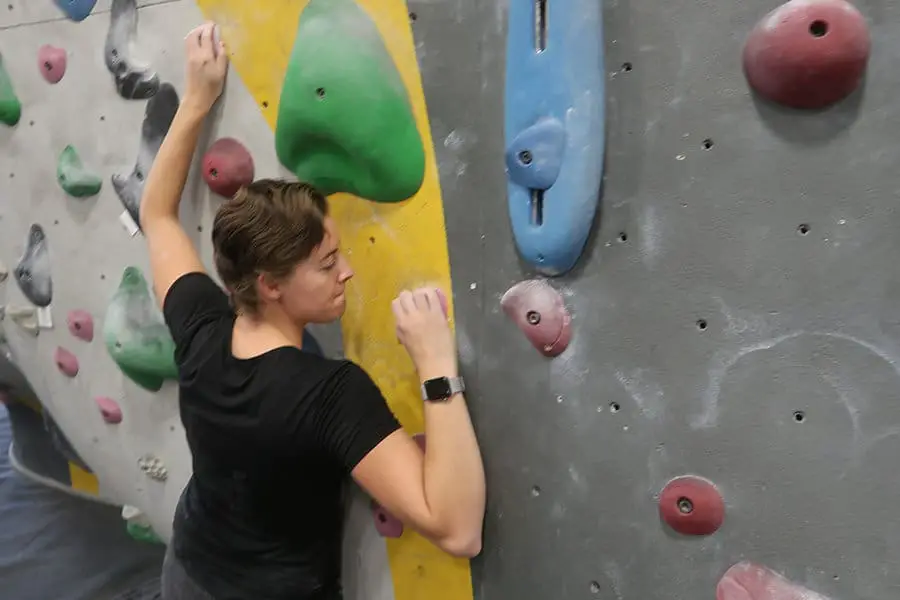
A crimp, also called crimping, can be an edge big enough for a few fingertips or just one or two fingertips.
According to a study that looked at the “biomechanical properties of the crimp grip position,” the crimp grip put about three times the force on the fingertip compared to a sloper hold during a warmup, which makes you more likely to get injured.
If you are crimping, pay attention to how your hand and wrist feel. If they get sore or start to hurt, stop climbing and let the tendons rest. If you keep going, you are at a higher risk of damaging your tendons and you can cause a long-term injury.
Crimping is usually broken into three grip types based on the angle of your fingers and where your thumb sits. They are the full crimp, the half crimp and the open crimp.
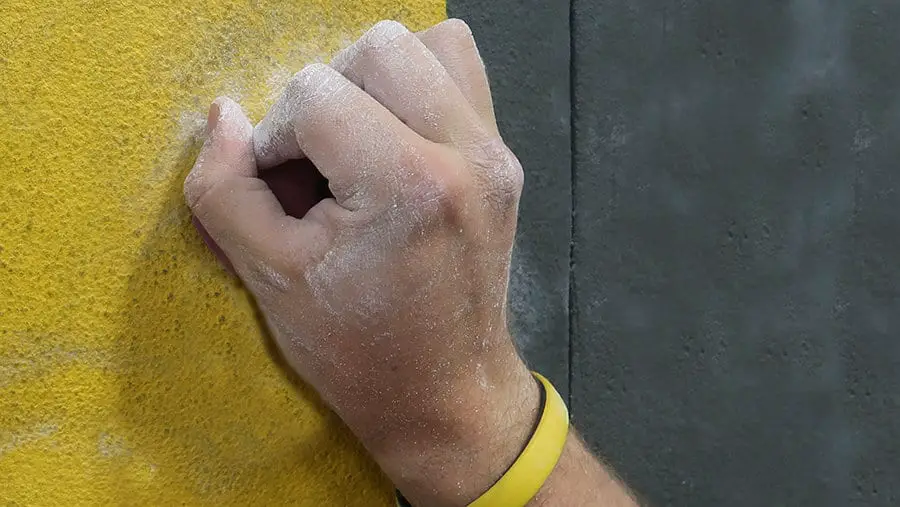
Full Crimp
A full crimp is when your fingers are at a full arch on the hold, resting on your fingertips and finger pads, with your thumb clasped on top. Climbers who are just learning to crimp often reach for this position because the thumb adds strength. The downside is that a full crimp puts the most strain on your fingers, so it’s the easiest grip to get hurt with. It engages the whole hand and it tempts you to rely on grip strength instead of good weight distribution, which loads the tendons in a way that can hurt you in the short term or the long term.
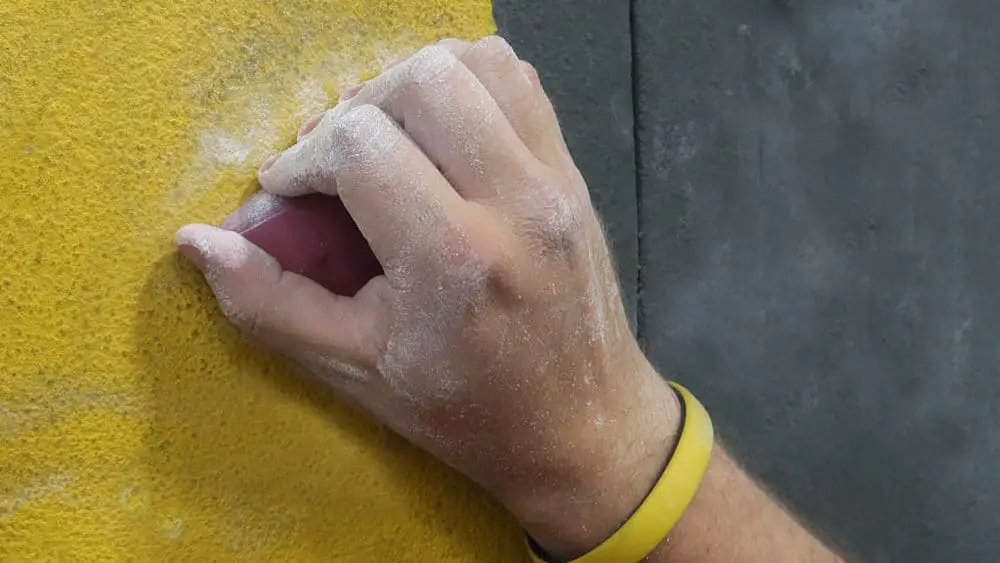
Half Crimp
A half crimp is when your fingers are at a full arch with your fingertips and finger pads on top of the hold, but your thumb stays off to the side and doesn’t help. This is the most common crimp position because it lets you push down and keep your fingers locked. Compared to an open crimp or drag, the half crimp lets you keep using the hold even as you move up above it. It’s safer than a full crimp, but you should still watch how your hand and wrist respond to each move and be careful not to overuse or strain your tendons.
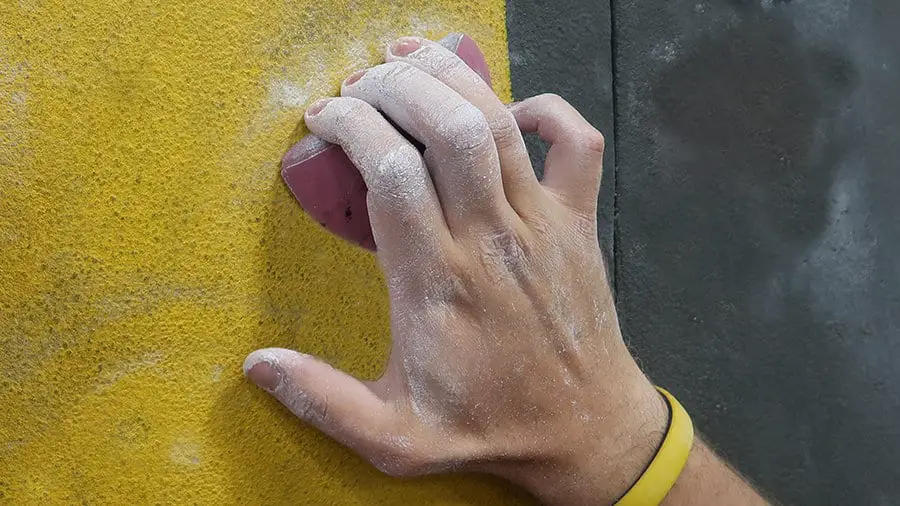
Open Crimp / Drag Grip
The safest way to use a crimp hold is with an open crimp, also called a drag grip. Unlike the full and half crimp, your fingers aren’t at a full arch and only your fingertips sit above the hold. There is much less strain on your hand tendons this way, which makes it the safest of the crimp grips, so use it as much as you can on crimp holds.
How To Make Crimping Easier For Beginners
If you are just starting out, or you have only been climbing a little while, you have probably caught yourself avoiding crimp-heavy problems.
That is really common and you aren’t alone. The catch is that if you never practice crimpy routes, it gets harder to keep progressing and it limits the problems you can do.
Here are two things you can focus on as a beginner to make crimping easier and open up more routes.
Move Your Weight / Center Of Gravity
One of the easiest things you can do with a crimp is move your weight in the opposite direction of the hold. That pulling movement makes it much easier to hang on with an open crimp.
Rely On Your Feet
Sometimes the footing on a crimpy route makes it impossible to put all your weight into your feet and legs, especially on overhangs. Most climbs, though, have footholds that let you stand up on your feet. If you are struggling to load your feet, reposition them so your center of gravity is directly above them. That turns the crimps into mostly balance points instead of holds carrying your full body weight. Dialing in your footwork pays off fast here.
If you like tips like these, the free Send Edition newsletter sends you one short climbing drill a week, about 15 minutes each. It’s a simple way to keep chipping away at limiters like crimping.
3 Ways To Train For Crimp Climbing
Since crimping is so hard on your hands, a lot of these tips are about building hand strength. If you would rather follow a plan that is built and progressed for you, the Grip & Grind app programs finger and crimp training so you don’t have to guess. If you like to run your own sessions, here are three ways to work on it, and our full grip training guide has plenty more.
1. Grip Donuts
Grip training is pretty basic and it lets you build hand strength quickly and conveniently. I prefer rubber grip rings over the spring-loaded grip handles most people know. Grip rings come in different resistance levels and they are completely quiet, unlike the handles that squeak every time you squeeze the spring.
Exercise Outline:
- Do the following on each hand 2 to 3 times per day with a grip trainer that is difficult to close. If it feels too easy, use a stronger one.
- Close the grip trainer quickly, then open it as slowly as you can, and repeat 7 to 10 times on each hand.
- Quickly close and open the grip trainer as many times as you can until you max out, meaning you are so worn out that you can’t close it any more.
2. 5-Second Rule
This one is good for all types of holds, and it’s especially good for crimps because they take so much more focus than other holds.
- Find an area with a lot of crimp holds. It doesn’t have to be one route with all the crimps, just an area where you can reach the holds easily.
- Climb the wall while trying to use only crimps to get up it.
- Hold each crimp for 5 seconds before you move your hand to the next one. The easiest way to do this is to load your feet so they carry the most weight before you move on.
3. Hangboarding
Hangboarding is one of the most popular training tools climbers use, but beginners should be careful. It’s one of the easiest ways to pick up a hand injury, so if you try it, pay attention to how your hands feel and stop if anything hurts. Start with two sessions a week with a couple of rest days in between. Once that feels too easy, it’s usually fine to go up to three a week, but no more.
Exercise Outline:
- Start with a 15-minute warm-up for your hands, wrists and arms.
- Pick 3 different crimp grips you want to train on the hangboard.
- With the first grip, hang for 10 seconds and rest for 5 seconds, then repeat 5 times.
- Take a 3-minute break.
- With the second grip, hang for 10 seconds and rest for 5 seconds, then repeat 5 times.
- Take a 3-minute break.
- With the third grip, hang for 10 seconds and rest for 5 seconds, then repeat 5 times.
3 Reasons Why You Should Love Crimps
- Crimping can be really rewarding, especially compared to other holds, when you see yourself improving and crimping starts to feel easier.
- Crimps are one of the most common holds indoors and outdoors, so getting good at them opens up a lot more climbs. It also makes you look good, since plenty of climbers struggle with crimps.
- Because crimping is so hard, climbers tend to read the whole climb and work out the sequence before they get on it. That gives you more practice planning your climbs and makes you a stronger, more competitive climber.
3 Reasons Why You Should Hate Crimps
- Over-crimping can cause short and long-term injury, including chronic pain, so listen to your body and stop climbing if you feel pain in your hands or fingers.
- Crimp holds are usually too small to rest on, so if you get tired you often have no choice but to keep going until you reach a better hold where you can take a break.
- Crimping is one of the biggest barriers to climbing harder grades, so if you can’t crimp well, you are more likely to plateau.
Conclusion
A crimp is a climbing grip you use when a hold is too small for anything but your fingertips. Crimping is one of the hardest hold types to use, and most hand injuries come from over-crimping, but it can be really rewarding once you can hang on to them. If you want to get better at crimps, it’s worth working your grip strength and trying drills like the 5-second rule above, and using the open crimp whenever you can to keep your fingers happy.
Frequently Asked Questions
What is a crimp in rock climbing?
A crimp is a small hold that has room for only your fingertips, and crimping is the grip you use on it, where just your fingertips touch the hold. Crimps show up most on more advanced climbs.
What is the difference between a full, half and open crimp?
In a full crimp your fingers are at a full arch with your thumb clasped on top, which is the strongest but the hardest on your tendons. A half crimp keeps the full arch but leaves the thumb off to the side. An open crimp, or drag, keeps your fingers flatter so only your fingertips sit above the hold, and it’s the safest of the three.
Is crimping bad for your fingers?
Crimping isn’t bad on its own, but it puts a lot of force through your finger tendons, so over-crimping is a common cause of hand injuries. Pay attention to how your hands and wrists feel, use the open crimp when you can, and stop if you feel pain.
How can I make crimping easier as a beginner?
Move your weight in the opposite direction of the crimp so you are pulling on it, and get your center of gravity over your feet so your legs carry the load. That turns crimps into balance points instead of holds that hang your full body weight.
How do you train for crimps?
You can build crimp strength with grip trainers, the 5-second rule on a crimpy wall, and careful hangboarding a couple of times a week. If you would rather follow a structured plan made for climbers, the Grip & Grind app programs your finger and crimp training for you.
Forearms pumping out early?
Crimps are one hold among many, and the one most often held badly. The Grip Efficiency guide covers how to hold things well, why forearms pump early, and when training your grip is actually the answer.