Read this and you’ll walk away knowing why the V5 plateau happens, which of four skills to sharpen first, and how to spend your sessions on V5 and V6 projects. In short: the habits that got you up V4 start running out of road, and the next gains come from steep-wall footwork, committing to dynamic moves, smarter grip choices and better project tactics.
What the V5 plateau is
Plenty of climbers sail through V3 and V4 and then spend a season or more trying V5s. It’s common enough that climbers call it the V5 plateau. Problems at this grade usually stack several demands at once:
- Steeper angles where both feet have to stay on through hard moves.
- Holds far enough apart that a static reach won’t get you there.
- Small edges that reward the right grip position.
- Sequences you can’t flash, so how you work a project starts to matter.
Each of those is learnable. The catch is that trying more V5s at full effort tends to rehearse the same mistakes.
What our assessment shows for climbers around V4 to V6
Our assessment groups grades into ranges. In the range covering V4 to V6, 144 recent finishers had a named main weakness, and four areas led the list:
- Core tension: 39 climbers
- Fear management: 30 climbers
- Grip efficiency: 25 climbers
- Route reading: 22 climbers
Because they’re pooled and anonymized across V4 to V6, these numbers describe the level as a group. The sections below show how each one tends to look on a V5 or V6.
1. Core tension on steep walls: your arms do all the work
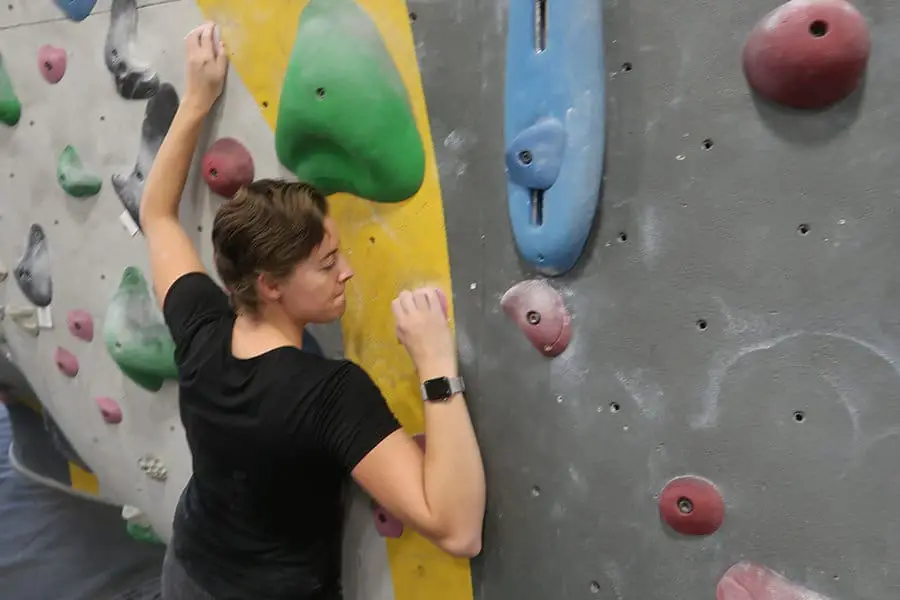
What it looks like on a V5 or V6:
- You can hang the start of a steep problem but run out of arm by the third move.
- You skip toe hooks and heel hooks because they feel slower.
- Your feet stay on until you need to move a hand, then both cut.
What the research says
The takeaway: On steep ground, staying balanced gets a little easier while holding on gets much harder. At V5 and V6, the gains come from making your feet pull, using hooks and toes driven into the wall to take load off your hands.
The finding (Noé, Quaine and Martin, Gait & Posture, 2001): Climbers held positions on a vertical wall and on an overhanging one, then released the right foot and regained balance. On the overhang, the arms carried a much larger share of the job of preventing a fall, and the sideways forces on the holds were smaller, which the authors read as balance being easier to keep.
How to use it: Do the hook-count drill below on the steepest wall at your gym.
Try this: count the hooks
- Pick a V3 or V4 on a steep wall or board.
- Climb it while adding a toe hook or heel hook wherever one fits.
- Count how many you found, then try to beat that number next go.
For the details on keeping feet on, read keeping your feet on steep walls.
2. Fear on dynamic moves: your eyes stay glued to your hands
What it looks like on a V5 or V6:
- You stall under a dyno and try to make it static.
- You commit halfway, touch the hold and let go.
- You only go for big moves on the last attempt of the day.
What the research says
The takeaway: Anxiety pulls your eyes onto the hold you're already holding. On a V5 or V6 dyno, the target is far away, so getting your eyes there first is part of committing.
The finding (Nieuwenhuys, Pijpers, Oudejans and Bakker, Journal of Sport and Exercise Psychology, 2008): Novice climbers did the same traverse high and low on a wall while their eye movements were tracked. When they were anxious, climbing and movement took longer, they made more and longer fixations mostly on the holds they were using, and their visual search slowed down.
How to use it: Use the eyes-first drill below on low dynamic moves before you take them onto a project.
Try this: eyes first
- Set up a dynamic move you can do with your feet just off the pads.
- Before you go, stare at the target hold for one full breath.
- Go while your eyes stay on the target. Add height only after five clean catches.
For more on mental tactics, read how a pro climber handles fear.
3. Grip efficiency: you full crimp everything
What it looks like on a V5 or V6:
- Every small edge gets your thumb locked over your fingers.
- Your fingers feel tweaky after board sessions.
- You can't hold an edge open-handed even when it's big enough.
What the research says
The takeaway: Full crimping is expensive for your finger pulleys. At V5 and V6, holding more edges with an open hand or a half crimp saves your fingers for the moves where only a crimp works.
The finding (Schweizer, Journal of Biomechanics, 2001): Measuring 16 fingers from four climbers, the study found the crimp grip caused the most bowstringing of the flexor tendon, less in a slope grip with the middle joint straight. In the crimp, the load over the A2 pulley was about three times the force at the fingertip, reaching up to 116 newtons.
How to use it: Try the open-hand warm-up below at the start of each session.
Try this: open-hand warm-up
- Climb three V2 or V3 problems using only open-hand or half-crimp grips.
- Repeat one of them on smaller holds if your gym has a board.
- Save full crimps for one or two moves per session on your project.
Pair this with exercises that help protect your tendons.
4. Route reading and projecting: you try the whole problem every time
What it looks like on a V5 or V6:
- Every attempt is a full go from the start.
- You're never sure whether a move is possible for you or just badly done.
- You forget your beta between sessions.
What the research says
The takeaway: Better climbers know which moves they can do, and they remember their plans. On a V5 or V6 project, testing moves one at a time builds that accuracy faster than repeated full attempts.
The finding (Whitaker, Pointon, Tarampi and Rand, Memory & Cognition, 2020): Climbers judged whether they could do single moves and then tried them. Skilled climbers were less confident but more accurate about what they could do. In a second experiment, more expert climbers also remembered holds better and planned and recalled move sequences more accurately.
How to use it: Run the move audit below on your current project.
Try this: the move audit
- Before trying each move on its own, guess yes, no or maybe.
- Try every move in isolation and write down the result next to your guess.
- Link the yes moves into sections, then join the sections. Note your beta on your phone before you leave.
Our guide to beta reading covers the planning side.
Stuck at V6: what changes one grade up
V6 usually keeps everything from V5 and turns up the volume. Climbers who've settled at V6 often report these patterns:
- Board problems and steep walls make up more of what's left to climb.
- Holds shrink, so finger strength starts to show alongside technique.
- Coordination moves, like running starts and paddle dynos, appear in more gyms.
- A single session rarely sends a problem, so recovery between sessions matters.
The same four areas above still apply. At V6, pick the one your falls point to, and add one short strength block per week once your technique sessions feel steady.
- Session A: Steep-wall footwork drill, then 30 minutes on your V6 project.
- Session B: Open-hand warm-up, then flash attempts on V4 and V5 problems.
- Session C: Move audit on a new V6, then one dynamic drill to finish.
If V5 still feels shaky, the techniques in our V4 to V5 progression guide are worth revisiting.
V5 plateau and V6: FAQ
What is the V5 plateau?
It's the stretch where climbers who moved quickly through the lower grades stop sending new V5s for months. At V5, problems start mixing steep footwork, dynamic moves and small holds, and old habits stop covering all three.
Why is V5 so much harder than V4?
V5 often asks for several skills on the same problem. Common ones include:
- Keeping both feet on through a hard move
- Committing to a dynamic catch
- Choosing the right grip on a small edge
How long does it take to go from V5 to V6?
It varies a lot. Climbers who work one focus area at a time and test moves in isolation on projects usually progress faster than those who only do full attempts.
Should I start fingerboarding at V5?
Finger strength starts to matter more around V6. If your technique sessions are consistent and you're healthy, a short, easy hangboard block can help. Build up slowly and stop if your fingers hurt.
Is V6 an advanced grade?
In most gyms, V6 is upper intermediate. It's a strong grade, and a lot of long-time gym climbers spend years working around it.
Do I need to project or flash at V5?
Both help. Flash attempts on V4 and V5 train reading and commitment. Projects on V5 and V6 teach you how to break a problem into parts.
Pick the right fix for your V5 plateau
Find out which of these four areas your climbing points to. The free Grip & Grind assessment takes about 10 minutes, and the result gives your next V5 or V6 session one clear job. A free trial is there if you'd like a full plan.
Take the free climbing assessment
Sources
- Noé F, Quaine F, Martin L. Influence of steep gradient supporting walls in rock climbing: biomechanical analysis. Gait & Posture, 2001.
- Nieuwenhuys A, Pijpers JR, Oudejans RRD, Bakker FC. The influence of anxiety on visual attention in climbing. Journal of Sport and Exercise Psychology, 2008.
- Schweizer A. Biomechanical properties of the crimp grip position in rock climbers. Journal of Biomechanics, 2001.
- Whitaker MM, Pointon GD, Tarampi MR, Rand KM. Expertise effects on the perceptual and cognitive tasks of indoor rock climbing. Memory & Cognition, 2020.