This page gives you a clear reason you keep topping out at V2 or V3, plus a simple drill to bring to the gym this week. Here’s the quick version: at these grades, what slows people down is how they balance, read and hold on, and that changes fast once you practice it on purpose.
Why can’t I climb past V2?
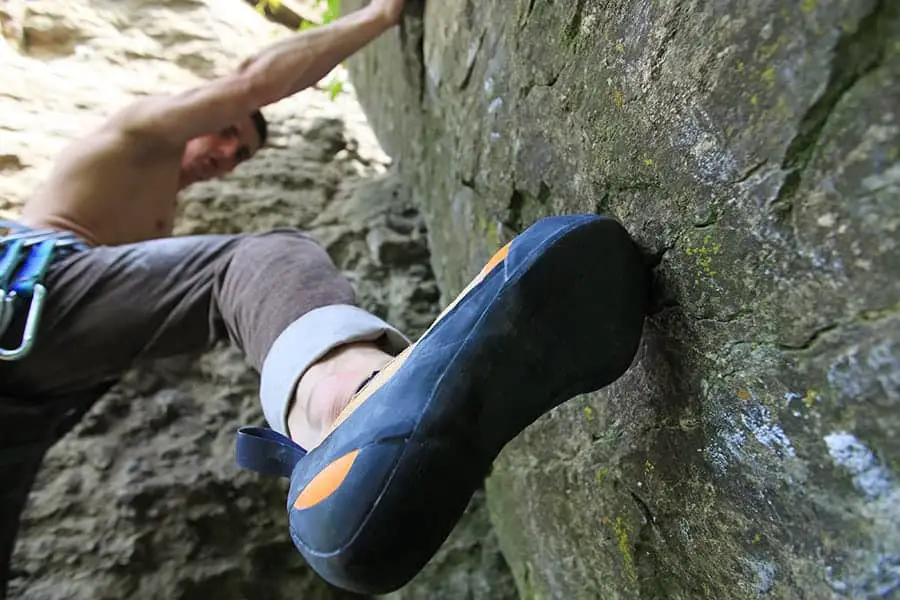
If V0 and V1 went quickly and V2 suddenly feels like a brick wall, you’re in good company. Big, friendly holds let you haul yourself up the easiest problems with your arms. Around V2, setters begin taking that option away. Here’s what usually appears for the first time:
- Footholds small enough that you have to look at them and place your toe with care.
- Sidepulls and gastons that only work if your body leans the right way.
- Reaches where you need to stand up on one foot before you can grab the next hold.
What the wall wants now is feet you trust and hips that move, and most new climbers haven’t practiced either yet.
What makes V3 feel different from V2
Once V2s go, V3 adds a layer of planning. Typical changes include:
- The order of your hands starts to matter, so one wrong grab leaves you crossed up.
- Walls tilt slightly past vertical and your feet start to swing off.
- Holds get a little worse, so death-gripping them burns your forearms in a few moves.
What holds climbers around V2 to V3 back
Every finisher of our free climbing assessment gets one main weakness. Across 334 recent finishers who climb around V2 to V3, here’s how often each area came out on top:
- Core tension and body control: 104 climbers
- Route reading: 62 climbers
- Grip efficiency: 58 climbers
- Body positioning and balance: 43 climbers
- Fear management: 36 climbers
These are anonymized totals for the V2 to V3 range as a whole. They show what’s common at this level. Your own answer can differ, which is why the quick check below and the full assessment exist.
1. Core tension and body control: you swing when a foot comes off
What it looks like at V2 and V3:
- You lift a foot to step up and your whole body twists away from the wall.
- You can reach the next hold but only by lunging, because you can't stay still on three points.
- Your hips hang low and far from the wall on every problem.
What the research says
The takeaway: Every time a foot leaves the wall, the other three points have to catch your weight, and the hand and foot on the opposite side are what stop the swing.
The finding (Quaine and Martin, Gait & Posture, 1999): Using four holds fitted with strain gauges, the researchers measured what happens when a climber hanging on the wall lets go with the right foot. The remaining three holds took over the vertical load, while the left hand and left foot handled the sideways forces that keep the body from swinging.
How to use it: Do the three-point pause drill below so lifting a foot stops feeling like a coin toss.
Try this: the three-point pause
- Pick a V0 or V1 you can climb easily.
- Before every foot move, freeze for two seconds and feel which three points are holding you.
- Lift the foot only once your opposite hand and foot feel firm. Repeat until it feels boring, then try it on a V2.
For more on staying stable, see the tripod position.
2. Route reading: the wall looks like random colored plastic
What it looks like at V2 and V3:
- You start climbing as soon as you find the start holds.
- Halfway up, you realize you're on the wrong hand for the next hold.
- You can't describe the problem to a friend after you fall off it.
What the research says
The takeaway: Skilled climbers see a wall as a list of actions. Asking "what does this hold let me do?" is a habit you can build from your first month.
The finding (Boschker, Bakker and Michaels, Journal of Motor Behavior, 2002): Expert climbers, novices and people who'd never climbed looked at a wall and then rebuilt the positions of 23 holds on a scale model. The experts remembered more holds, recalled them in groups, and focused on how each hold could be used. People with no experience mostly remembered what the holds looked like.
How to use it: Use the action-naming drill below before every attempt at V2 and V3.
Try this: name the action
- Before you pull on, point at each hold and say what it's for, such as "pull down", "lean left" or "step high".
- Decide which hand goes first on each hold.
- After you climb, check whether the wall matched your plan and fix the next attempt.
Our guide to planning moves before you leave the ground goes further.
3. Grip efficiency: your forearms are done after three problems
What it looks like at V2 and V3:
- Your knuckles go white on jugs.
- Your session ends early because your forearms are pumped, while your legs feel fresh.
- You hang on bent arms while you look for the next hold.
What the research says
The takeaway: Everyone squeezes harder than they need to, and the waste is biggest when the load is light. Easy holds are where you can learn to relax your grip.
The finding (Danion, International Journal of Sports Medicine, 2008): This study measured how much extra grip force people use beyond the minimum needed to stop an object slipping. With a light object, non-climbers used about 386% of that minimum as extra force, while expert climbers used about 232%. With a heavy object, both groups were close to each other.
How to use it: Practice the soft-hands drill below on your warm-up problems.
Try this: soft hands
- Climb a V0 using the lightest touch that still keeps you on.
- Every time you stop, straighten your arms and let your skeleton hang.
- Climb the same problem again and try to make it quieter and lighter.
Pair it with straight arms to save even more energy.
4. Body positioning: you reach with your arm before your hips are ready
What it looks like at V2 and V3:
- You face the wall square-on for every move.
- Long reaches feel impossible until a taller friend shows you a different body position.
- You fall off sidepulls because your weight is on the wrong side.
What the research says
The takeaway: A good reach begins in your hips and feet before your hand lets go. Set your body first, then move the hand.
The finding (Testa, Martin and Debû, Gait & Posture, 1999): The team measured forces on the holds while climbers reached for a new hold, changing the hold type and the size of the reach. Before the hand even moved, climbers adjusted their posture. Sideways adjustments mainly kept them balanced, and the vertical push mainly helped start the reach.
How to use it: Try the shift-then-reach drill below to build that order into every move.
Try this: shift, then reach
- On a V1 or V2, say "shift" out loud before every hand move.
- Move your hips over the foot you'll push from, or turn a hip into the wall for a sidepull.
- Only then reach. Count how many moves felt easier than usual.
See hip turns for the next step.
A quick word on fear at V2 and V3
Fear came out on top for 36 climbers in this range. At these grades it usually shows up on the top-out or the first problem where you're high off the pads. Short, planned practice falls from low heights help a lot, and this interview with a pro climber on fear has more ideas.
A simple four-week plan
- Week 1: Use the quick check above, pick one area, and spend 15 minutes of each session on its drill.
- Week 2: Keep the same drill, and try two V2s or V3s you've failed on before.
- Week 3: Add the drill from a second area, starting on V0 and V1 again.
- Week 4: Test yourself on a handful of new V3s and note which ones felt different.
Stuck at V2 or V3: FAQ
Why can't I climb past V2?
V2 is often the first grade where the holds stop doing the work for you. The usual reasons climbers stall there are:
- Feet placed without looking
- Hips that stay far from the wall
- Grabbing every hold as hard as possible
All three improve with a few weeks of focused practice.
Is it normal to be stuck at V3 for months?
Yes. V3 is where a lot of gym climbers settle, especially if they climb the same style of problem every week. Picking one skill and drilling it on purpose usually gets things moving again.
Is strength what's stopping me at V3?
Rarely. Problems at V2 and V3 are mostly about balance, footwork and reading. If you can hang on a big hold for a few seconds, you've got the strength for the grade.
How do I know when I'm ready for V4?
When most V3s at your gym go in a few tries and you can explain why each one worked, start trying V4s. Our guide to our V4 and V5 technique guide is a good next read.
Why do V3s at my gym feel so different from each other?
Grades depend on the setter and the wall angle. A slab V3 tests balance. A steep V3 tests tension. If you only send one style, you've found your next focus.
Is the assessment useful if I'm still a beginner?
Yes. It takes about 10 minutes and works for any grade. At V2 and V3, knowing your main hold-up early saves you months of trying random things.
Know what to practice before your next session
Stop guessing which drill to do. Our free climbing assessment takes about 10 minutes and tells you the area that's holding you back most at V2 and V3. Want a plan shaped around your result? Grip & Grind offers a free trial.
Take the free climbing assessment
Sources
- Quaine F, Martin L. A biomechanical study of equilibrium in sport rock climbing. Gait & Posture, 1999.
- Boschker MSJ, Bakker FC, Michaels CF. Memory for the functional characteristics of climbing walls: perceiving affordances. Journal of Motor Behavior, 2002.
- Danion F. Grip force safety margin in rock climbers. International Journal of Sports Medicine, 2008.
- Testa M, Martin L, Debû B. Effects of the type of holds and movement amplitude on postural control associated with a climbing task. Gait & Posture, 1999.