
Ask a strong climber where their gains come from and lower body mobility for climbing usually lands near the top of the list. The pros treat it like real training, not an afterthought. Most professional climbers have reported spending between 30 to 60 minutes every day on training these two things. Janja Garnbret, for example, in her earlier years as a professional youth climber, was known for spending half of her climbing session focused on mobility.
Here is the catch. Mobility and flexibility are also the first things beginner and intermediate climbers skip. This challenge was built to fix that. You add a little of this work to your daily routine, and 30 days later you are moving through positions that used to shut you down. If you want your feet higher and your hips closer to the wall, this is where it starts.
Challenge Overview
Who Should Participate?
There have been an embarrassing number of times I have thought to myself, “if I could get my foot a little higher, I could finish that route.” If that sounds like you, this challenge is exactly what you need. It is here to help everyone who joins get more mobile and flexible so they can send more routes. Getting your feet higher is part footwork too, so it pairs well with some footwork drills for climbing on the wall.
What Equipment Is Needed?
This challenge is bodyweight flexibility and mobility flow training, so you do not need any equipment. Some people like using a yoga mat, but it is not necessary.
What Does The Challenge Entail?
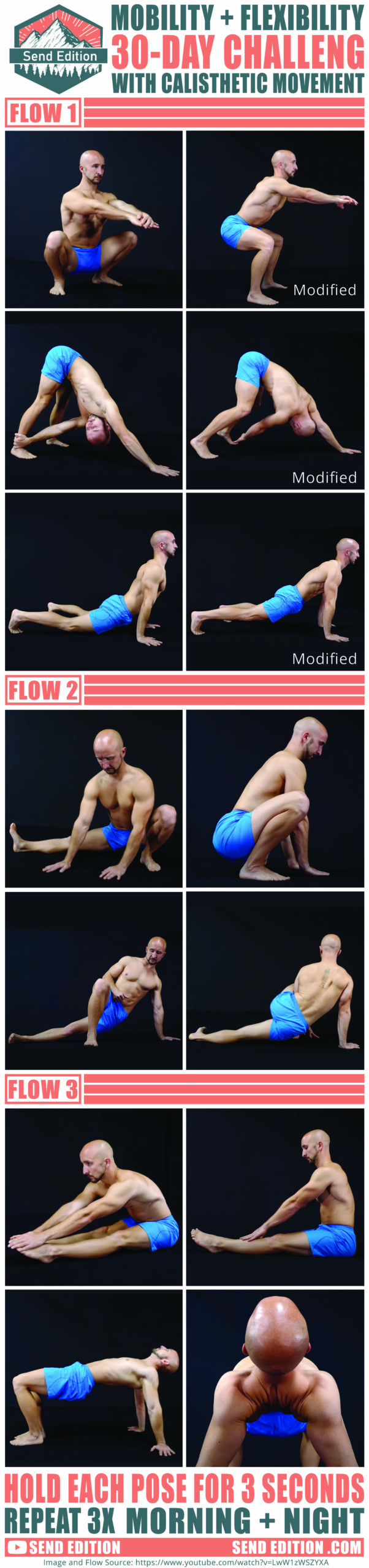
Every morning and night, run through this 5-minute flexibility and mobility routine from Calisthenic Movement for 30 days. That is it. Two short sessions a day, no gear, no excuses. If you want to prime your hips before a session, this routine also works as a solid warm-up before climbing.
Challenge Routine Overview
It is not a follow-along video like I hoped for, so here is the outline of the flows in case you want a copy of it:
The Routine:
Flow 1:
- Deep squat
- Pike stand reach
- Cobra
Flow 2:
- Archer squat
- Shaolin sit
Flow 3:
- Toe touch
- Easy bridge
Instructions:
Hold each position for 3 to 5 seconds
Reps: Repeat the routine 3 times with NO REST
Frequency: Morning and Night
► Here is a printable PDF
Why This Routine for Lower Body Mobility for Climbing?
For this challenge, I researched over a dozen programs that could work for lower body mobility for climbing. The problem was that most of them asked for too much. So I got strict with my criteria to narrow things down to something anyone could actually stick with.
Criteria:
- Mainly focus on lower body, specifically the hips
- Anyone can do it, no matter their flexibility
- 20 minutes or shorter (easier to commit to)
- Free to access
- Capable of repeating daily
- Can be continued after the challenge period ends
That criteria cut a lot of options, but I still had to sift through half a dozen videos to find the right one. In the end I landed on two YouTubers who are well known for their flexibility and mobility work. I went with the one that seemed easiest to memorize and see progress from. Plus it is under five minutes long, so there really is not an excuse for missing a day.
Want more small habits like this that actually move the needle? Send Edition’s free newsletter drops one short climbing drill in your inbox every week, about 15 minutes each. Grab the weekly drills here and keep the momentum going once the 30 days are done.
What is Mobility and Flexibility?
Before we get into the ins and outs of the challenge, it helps to understand what mobility and flexibility actually are and how they work together.
A lot of people treat mobility and flexibility as the same thing, but they do two different jobs. Flexibility is being able to stretch and hold a specific shape, like the splits. Mobility is being able to freely move your limbs into that shape, like raising your leg up to an adjacent hold and settling your body into that position.
Think about the movement of your leg. Getting it up there takes strength, and that is the mobility side of the shape. Being able to stretch the muscle and hold the shape is the flexibility side. They work together, but just because someone is flexible does not mean they are mobile.
There is very little use in being able to drop into the splits on the ground when it comes to climbing. You need to stretch your legs that far apart and also raise your leg and put weight through it while at full extension. If your hips feel tight going into this, some foam rolling between sessions can help you recover and move better.
Staying on the wall
Mobility is one of the things climbers neglect until it costs them. The Injury and Recovery guide covers what actually goes wrong, how to make it less likely, and what helps once something already hurts.
Frequently asked questions
What is the difference between mobility and flexibility?
Flexibility is being able to stretch and hold a shape, like the splits. Mobility is being able to move your limbs into that shape under control, like raising your leg to a high hold and putting weight through it. You can be flexible without being mobile, which is why this challenge trains both.
Do I need any equipment for this challenge?
No. It is all bodyweight flexibility and mobility flow training. A yoga mat is nice if you want a little cushioning, but it is not required.
How long does the daily routine take?
The routine is under five minutes. You hold each position for 3 to 5 seconds and repeat the full set 3 times with no rest, once in the morning and once at night, for 30 days.
Why focus on lower body mobility for climbing?
Better hip and lower body mobility lets you get your feet higher, keep your hips close to the wall, and hold positions that used to feel impossible. That is often the difference between falling off a route and finishing it.
Can beginners do this challenge?
Yes. One of the criteria for picking this routine was that anyone can do it, no matter their current flexibility. It scales to where you are and you can keep doing it after the 30 days are up.