This post contains affiliate links. If you buy through them, I may earn a commission at no extra cost to you.
Watch someone good on a steep problem and the thing that stands out isn’t how hard they are pulling. It’s how often they aren’t pulling. They set a heel, the position locks, and suddenly a move that should be a fight is just a move.
Hooks get filed under advanced technique, which is backwards. They exist to reduce how much strength and tension a move requires, so the climbers who benefit most are the ones with the least of both to spare. But if your shoe has a soft heel cup or slick rubber, you are fighting the gear before you even get to the move.
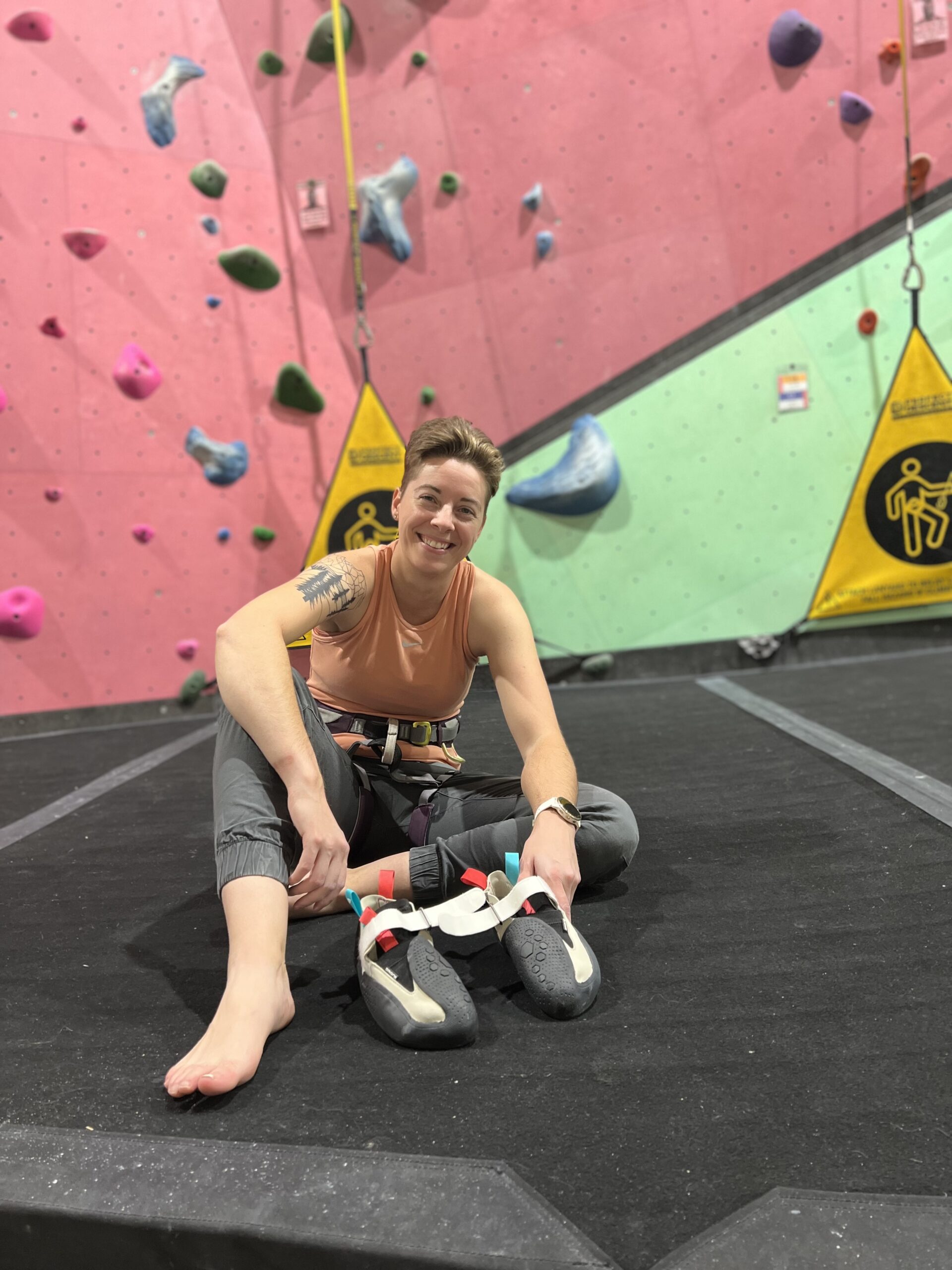
What makes a shoe good for hooking
Three things matter: a stiff heel rand that holds its shape under load, sticky rubber that grips when you pull, and a snug fit so the shoe doesn’t rotate on your foot mid-hook.
Soft, stretchy shoes are great for smearing and edging, but they collapse under a hard heel pull. You want a shoe that stays rigid when you drive with your hamstring, so all that force goes into the hold instead of deforming the cup.
Rubber compound matters more than tread pattern. Softer rubber grips better on plastic and rock, but it wears faster. Most hooking specialists use Vibram XS Edge or Grip2, or the stickiest version of whatever their brand offers.
La Sportiva Solution: the hooking standard
This is the shoe you see on every steep problem in every gym. The heel cup is stiff, the rand wraps all the way around, and the rubber is sticky enough that a well-set hook feels like it is glued on.
The downsides: it’s expensive, it’s aggressive, and the fit is narrow. If your foot is wide or you aren’t ready for a downturned shoe, this will hurt. But if the fit works, it’s the benchmark every other hooking shoe gets compared to.
Check current price at Backcountry
Scarpa Instinct VS: softer fit, same grip
The Instinct has a slightly less aggressive downturn than the Solution, which makes it more tolerable for longer sessions. The heel is still stiff, the rubber is Vibram XS Edge, and the fit is a bit wider through the toebox.
Climbers who find the Solution too narrow or too painful often land here. It hooks nearly as well and doesn’t punish your feet as much on routes where you are standing on edges between the steep bits.
Five Ten Hiangle: wide feet, steep problems
If your foot is wide and the Italian brands don’t fit, the Hiangle is the answer. The heel cup is reinforced, the Stealth C4 rubber grips as well as anything, and the fit is generous without being sloppy.
It’s less downturned than the Solution or Instinct, so it works better on vertical ground and worse on roofs. But for someone who needs a wider shoe and still wants to hook hard, this is the one.
Check current price at Backcountry
What each hook does
The heel hook
You put your heel on a hold and pull with it. Your hamstring and glute do the work instead of your arms and core.
This matters because those are big muscles that fatigue slowly, and because pulling with a leg changes the geometry of the whole position. A heel hook can hold your hips into the wall on ground where your core alone would be failing, which means your feet stay on and your arms stop taking everything.
The toe hook
You catch the top of your foot under or behind something and pull your body toward the wall.
A toe hook doesn’t help you move upward. It stops you swinging away, which on steep ground is the thing that keeps ending your attempts. It’s the direct answer to a body that keeps rotating off the wall on a reach.
When to reach for which
The rough rule: heel hooks help you move, toe hooks stop you being pulled off.
- Heel hook when you need to pull yourself toward a hold, when you want to take weight off your hands at a rest, when the next hold is high and to the side, or on a topout where you need to get your weight over the lip.
- Toe hook when your body wants to swing away from the wall, on roofs, under overhangs where nothing else keeps you in, and to stop a barn-door before it starts.
- Both at once is common on steep ground, and it is what a lot of compression climbing actually is.
Reading which one a hold wants is a skill in itself. Big incut holds, the tops of volumes and anything with a lip generally take a heel. Anything you can get the top of your foot behind takes a toe.
How to actually set one
Heel hook, step by step
- Place the inside back edge of your shoe on the hold, not the flat underside. That edge is where the rubber and the shape of the heel cup do their work.
- Point your toes slightly outward, which rolls the heel into the hold rather than balancing it on top.
- Pull. This is the step people skip. An unengaged heel is decoration. Drive with the hamstring as though you are trying to bring the hold toward your hips.
- Keep pulling as you move. The hook holds while it’s loaded and slides the moment it isn’t.
Toe hook, step by step
- Get the top of your foot against the hold, laces down toward the wall.
- Point your toes and pull your foot toward your body, so the hook tightens rather than resting.
- Expect it to feel unnatural. Toe hooking uses muscles on the front of your shin that you rarely load in daily life, and they will fatigue quickly at first.
Common mistakes
- Placing a hook and not pulling with it. This is the big one. A hook that isn’t loaded does nothing at all.
- Hooking with the bottom of the heel. The inside back edge is what grips. The flat underside slides.
- Setting the hook, then moving so the direction of pull changes. A hook works in one direction. Move your body and you can unload it without meaning to.
- Saving hooks for hard problems. They are easiest to learn on easy terrain, where you have attention to spare and falling costs nothing.
- Committing hard to a heel while cold. Warm up first. Hamstrings don’t enjoy a sudden maximal pull at full extension.
Where this fits in your progression
You can start on both the day you first get on a steep problem. There is no strength prerequisite, which is the point.
What does develop over time is recognition: seeing from the ground that a hold will take a heel, and knowing before you commit which direction you will need to pull. That comes from mileage on steep terrain rather than from practising the hook in isolation.
Hooks also reduce the amount of body tension a move demands, so they are worth learning alongside tension work rather than instead of it.
How to train this
Both hooks respond well to deliberate, low-grade practice:
- Heel hook everything. Pick an easy steep problem and use a heel hook on every move where one is remotely possible, including the ones where it is clearly unnecessary. You are building recognition, not efficiency.
- Hook and hang. Set a heel on a good hold, then take both hands off for a moment. Nothing teaches you the difference between a placed hook and an engaged one faster.
- Roof traverse. Find the steepest short traverse in the gym and cross it using toe hooks to stay in. Your shins will complain. That is the muscle you weren’t using.
Ten minutes at the start of a steep session is plenty. These are skills, and skills learn best when you are fresh.
Related techniques
Hooks work together with:
Frequently asked questions
What does a heel hook actually do?
It turns your leg into a pulling limb. Instead of pressing down through your toe, you hook your heel over a hold and pull with your hamstring and glute. That takes load off your arms and, more importantly, off the core tension that would otherwise be holding your body in position. It’s why steep climbing looks restful for some people.
What is the difference between a heel hook and a toe hook?
A heel hook pulls you toward the hold, usually upward or sideways, and is mostly hamstring and glute. A toe hook pulls you into the wall by catching the top of your foot under or behind something, and it stops your body swinging away on steep ground. Heel hooks help you move. Toe hooks stop you being pulled off.
Are heel hooks an advanced technique?
No, and treating them as advanced costs beginners years. They are load-reducers, which means the climbers who most need them are the ones who have the least strength to spare. Learn them early and steep terrain becomes accessible sooner.
Why does my heel keep slipping off?
Usually one of three things. You placed it and never pulled with it, so it’s just resting there. You are hooking with the wrong part of the shoe, which should be the inside back edge rather than the very bottom. Or your body has moved so the direction you are pulling no longer matches how the hook is set.
Can heel hooking injure you?
It can strain a hamstring if you load one hard and cold, particularly at full extension. Warm up before you commit to hard hooks, engage gradually rather than snapping into them, and back off anything that feels sharp behind the knee.
Do I need an aggressive shoe to heel hook?
No, but you need a stiff heel cup. An aggressive downturn helps on roofs because it keeps your toe engaged while your heel pulls, but the heel itself just needs to be rigid and sticky. A flat shoe with a reinforced rand will hook better than a soft aggressive shoe.