A dab is when a climber accidentally touches something outside the route, like a pad, tree branch, or wrong hold. It’s rarely a big deal, but it’s a classic way climbers needle each other about whether a send was truly clean.
In this article I’ll walk you through everything you need to know about dabbing and how and when to use the word in your climbing vocabulary. If you don’t feel like reading the whole thing, here’s the one-sentence version.
What does dabbing mean? Dabbing is when a climber mistakenly touches something that isn’t meant to be used on that route.
If you want the full picture, keep reading. Dabbing is one of those bits of climbing slang that shows up everywhere once you know it, right alongside the rest of the gym vocabulary in our bouldering and sports climbing glossary.
What Is Dabbing In Climbing?
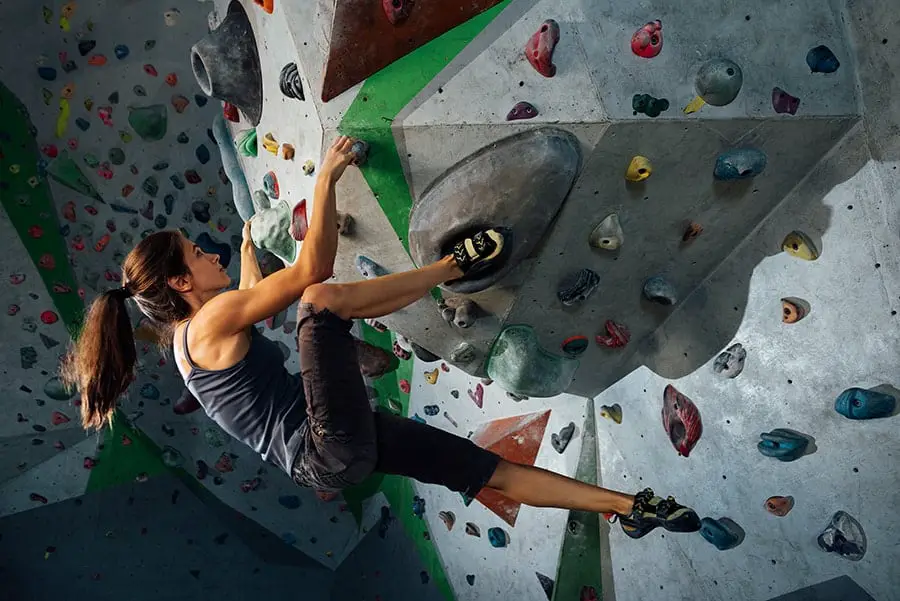
Dabbing is an action a climber makes, usually by accident, that ends with you touching something that isn’t part of the climb. Out at the crag you might brush a pad, a tree branch, or a nearby rock. In the gym you might graze a foothold or a hold that isn’t part of your route. Either way, that stray touch is a dab, and someone nearby will almost always notice.
What Causes Dabbing?
The biggest cause of dabbing is a lack of core strength, or just losing focus on your core mid-move. When your midsection gives out, your foot or hips drop, and that’s usually the moment you clip something you weren’t supposed to.
Most dabbing happens at the crag because boulder problems start so low to the ground. There’s just more stuff within reach down there.
People with longer limbs tend to run into it more too. As they move from one part of the boulder to the next, a foot can swing wide and graze a pad or a branch. If that’s you, the fix is still the same: build the core control to keep everything tight and where you want it. It’s one of the quieter reasons bouldering is so hard, since you’re controlling your whole body in a tiny space.
Does Dabbing Matter?
For some climbers, dabbing is a marker of the “integrity” you bring to a climb. The thinking goes that if you dabbed, that touch might have helped your ascent, so it wasn’t a truly clean send.
Honestly though, most of the time dabbing is just a passive-aggressive way for climbers to tell their friends to quit celebrating because the send wasn’t spotless.
If you scroll through any forum thread about dabbing, you’ll find piles of sarcastic comments, because it’s way more of a running joke than an actual rule.
One of my favorite comments I’ve come across is this one from an article on Climbing Narcissist.
“Personally I don’t count any send under 7,000 feet because I consider the atmospheric density of low altitude problems a “full body dab”. While I recognize this is a bit strict, I also believe it exemplifies a divine no-dab ethos. Because at the end of the day we all have to look ourselves in the mirror and come to grips with our dabbiness. And who amongst us really wants to be a “tree dabs count” person?”
When Should You Yell “Dab” At Someone?
In general, climbers don’t love getting yelled at, and they really don’t love it when it’s about dabbing. That’s because calling dab suggests their climb doesn’t quite count and isn’t worth the praise, since it wasn’t a clean send. Yelling it at friends in good fun is usually fine though.
Avoid yelling dab at strangers or people you don’t know well. If you’re getting along with someone enough that a friendly dab call would land, here are the situations where it actually applies.
- Getting a power spot through a move
- If your toe, hand, butt, or anything else touches a ledge, an adjacent boulder, a tree, and so on
- When your spotter accidentally bumps you (yep, that’s a dab)
- Kicking a spotter in the face
What’s Not Dabbing?
Now that you know what a clear dab looks like, it’s worth knowing what doesn’t count, so you don’t end up miscalling it and annoying your friends by fake-busting them when they didn’t actually dab.
- When a beanie or chalk bag falls off mid-climb
- If something tosses out of your pocket, like a chapstick, while you’re climbing
- A butterfly landing on your hand while you’re on the wall
Questionable Dabs
Since a dab carries almost no real consequence but is still a popular part of climbing, it’s worth remembering that not every situation is black and white.
Here’s a list of gray-area moments to chew on:
- When your hair touches the ground
- If your chalk bag grazes the ground
- If someone hands you a chalk ball while you’re climbing
- What if you fist-bump someone before topping out?
- If your feet swing out and brush against a bush
Sorting out calls like these is half the fun of gym culture, and it’s the same kind of shared language that makes climbing so popular in the first place. If you want more of these little climbing habits and bits of beta landing in your inbox, my free newsletter sends one short, practical climbing drill you can do in about 15 minutes each week. You can grab it here and level up your climbing with 15 minutes of training.
Conclusion
Dabbing is when you touch something that isn’t meant to be touched while you’re climbing. Because it’s an accident and usually doesn’t change how you get up the climb, it doesn’t matter much. But since deliberately using stuff that isn’t part of a route counts as cheating, dabbing sits right on the line between a clean ascent and a cheated one.
Since that line matters to some climbers, calling someone out for dabbing has turned into a passive-aggressive, sarcastic way of saying they didn’t do a clean climb and maybe don’t deserve the celebration.
Mostly it’s used to sarcastically knock someone down a peg while they’re high on life after getting through a climb.
Bottom line: if you don’t know the person, it’s best not to call dab on them. If you’re friends and they’re tough-skinned, then busting them for a dab is probably fair game. Learning calls like this is part of picking up the culture, and it pairs nicely with knowing the common beginner mistakes so you spend less time dabbing and more time sending.
Frequently asked questions
What does dabbing mean in climbing?
Dabbing is when a climber accidentally touches something that isn’t part of the route, like a pad, a tree branch, an adjacent boulder, or a hold that isn’t on your problem. It’s almost always unintentional, and it’s the reason someone in the gym might yell “dab!” when you touch something you weren’t supposed to.
Is a dab against the rules?
Not really. A dab has almost no real consequence and is mostly a running joke among climbers. It only matters because it sits on the line between a clean ascent and using something you shouldn’t, so some climbers treat it as a sign your send wasn’t perfectly clean.
Does a dab count as a clean send?
Strictly speaking, some climbers say a dab means the send wasn’t clean, since that stray touch could have helped your ascent. In practice most people treat it as a lighthearted jab rather than a serious ruling on whether the climb counts.
Should you yell “dab” at someone?
Only if you know them well. Climbers don’t love being told their climb doesn’t count, so calling dab on a stranger comes off rude. Among tough-skinned friends, a friendly dab call for a power spot, a spotter bump, or a stray touch is usually all in good fun.
What isn’t a dab?
A beanie or chalk bag falling off mid-climb, something tossing out of your pocket, or a butterfly landing on your hand don’t count as dabs. Those are just random things happening on the wall, not you touching something that was meant to be off-limits.
New to climbing?
Gym culture takes a while to pick up. The Climbing for Beginners guide answers the rest of the first month questions in one place, from what to wear to what the grades mean.