Heading to a bouldering gym for the first time? If you’re anything like me, you want to know what you’re getting into before you walk in the door. Maybe you’re going on a date and want to impress someone cute, or maybe you just want to know what to do once you get there. Either way, here’s what you need to know for your first time at a bouldering gym.
And if all else fails, just try to have fun with it. The trip will be worth it. New to the sport entirely? It helps to read up on what bouldering actually is before you go.
Rent Shoes
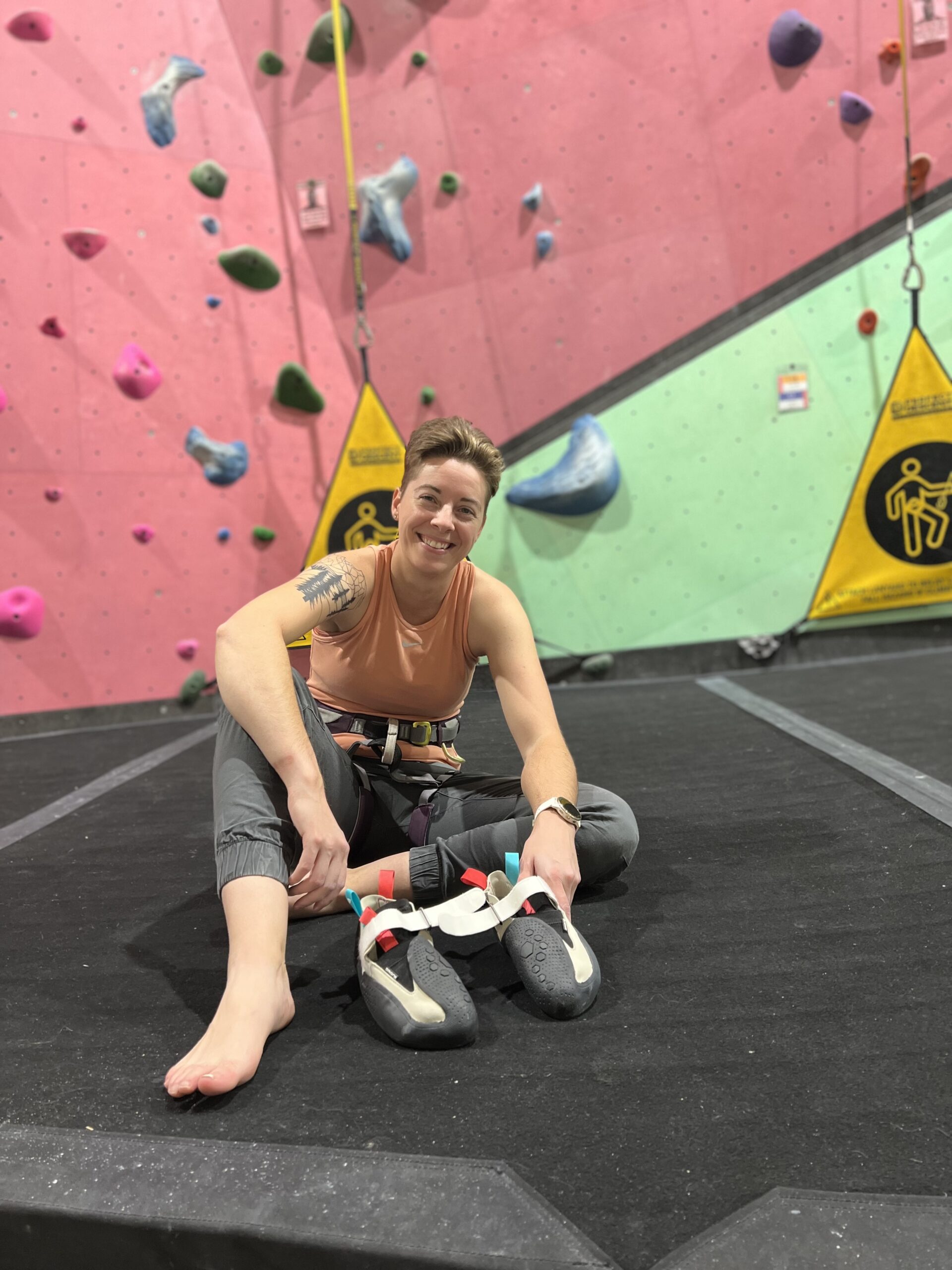
When you sign your life away on the liability waiver at the front desk, ask to rent climbing shoes. I’ve seen so many people try to save the $3 to $5 and skip the rental, then climb in their tennis shoes instead.
Tennis shoes aren’t good for climbing.
If you want the specific reasons to spend the extra few bucks, here’s the quick version:
- Tennis shoes have a lot of space between the end of your toes and the front of the shoe, so you can’t get up on the tips of your toes as easily.
- The toe on tennis shoes is usually too big for the small climbing holds, so you’ll be limited in what routes you can try.
- Climbing shoes use really grippy rubber, so you can stand on the wall without a foothold, unlike the rubber on tennis shoes.
- Climbing shoes have extra stiffness at the toe and the ball of your foot, so you don’t have to use as much muscle in your foot to hold yourself up.
Climbing shoes won’t just make it easier to climb, they’ll open up a lot more routes you can actually do. If you want to know what else you do and don’t need on day one, here’s a rundown of the minimal gear needed for bouldering.
Shoe Fit
Climbing shoes usually run smaller than your street shoes. If they’re too big, it’s harder to stand on small footholds, so you don’t want them too roomy. At the same time, you want the smallest pair you can get without it hurting.
Discomfort is fine, but pain means they’re too small.
If you go with a pair that feels questionably small, try a couple of climbs first. If they hurt or distract you while you’re on the wall, head back to the front desk and ask for a different size.
Choosing The First Route Or Climb
Once your shoes are on and you’ve warmed up a little, it’s time to find your first climb. Look around the gym for some sign of how hard each climb is.
Most gyms have a little piece of paper taped beneath the holds around waist height. The paper tells you the grade of the climb, and the grade is just how difficult it is. If you want the full breakdown, here’s how climbing routes are graded.
Bouldering in the U.S. uses a “V grade” scale. The beginning grades are VB and VE, then it runs from V0 to V13. For your first climb, try a VB or V0 to start, then work your way up one grade at a time. If you send a V0, try a V1, and keep moving up until you hit a level that’s challenging but still doable.
Starting The Climb
To start a climb, put both hands on the start hold. The start hold is the one with the tape that tells you the level of the climb.
Sometimes there’s a second piece of tape or paper, and that means you’re supposed to have one hand on each hold to begin.
Once your hands are on, put your feet on a hold of the same color and start climbing.
Doing The Climb Or Route
The tricky part of indoor bouldering is that you’re supposed to climb a specific route. The route is marked by color, either by the color of the handholds or by colored tape underneath them. Those colors make up a sequence, and climbers usually call that sequence a “problem.”
Follow the sequence all the way to the top of the climb.
If you’re really struggling, I always find that finishing a climb by “cheating” is a nice confidence booster. To cheat, just use handholds that aren’t part of the intended route. So if you can’t get past one section, grab a different colored hold to reach the next part of the climb.
Cheating is still cheating, though. So if you notice a pattern of needing to cheat, it’s probably better to drop down to easier grades and work your way back up.
Finishing The Climb Or Route
To properly finish a climb, you don’t just need to reach the top hold, you need to make a finishing move too. Depending on the gym, there are three common ways to finish.
- Put both hands on the last hold, which is marked as the finish or is the last hold of that color.
- Climb onto the top of the wall (this only applies if you’re supposed to stand up on top and walk over to a climb-down area).
- Grab the top of the wall with both hands.
Once you’ve reached the top, use any hand or foothold to climb back down. You can jump down if the floor is well padded, but jumping raises your chance of getting hurt, so avoid it if you can.
Tips For Your First Time At A Bouldering Gym
Use Your Toes
One of the easiest ways to make climbing feel easier is to climb on your toes. Beginners tend to stand with the middle of the foot on the hold. When you get on your toes instead, you can stand up taller, pivot, and move around a lot more easily.
Review The Route Or Problem
Look over the route before you get on the wall. Checking all the holds first gives you an idea of where you need to move to reach the top. It saves you from wasting energy figuring out the next move while you’re hanging on.
Talk To Other Climbers
Whether you’re talking to your date or to someone who just finished a climb, chatting with other climbers helps you feel more comfortable being there.
As a beginner, you might not know that giving other climbers unasked-for advice on their climbs is a big no-no. So here’s your warning: don’t hand out beta to other climbers unless they ask for it.
If the idea of showing up solo feels intimidating, don’t worry. You absolutely can go on your own, and there are real upsides to it. Here’s the case for going bouldering alone.
Conclusion
Whether you’re trying to impress your date or you just want to know what to expect on your first time at a bouldering gym, the rundown above should get you sorted. A good place to start is renting shoes and then climbing a few basic routes.
Most climbers are genuinely nice to talk to, so you can always ask someone at the gym if you get stuck or aren’t sure what to do. Bouldering is pretty safe, but it’s still worth knowing how dangerous indoor bouldering can be before you push yourself too hard.
Once you’ve visited the gym, you might catch the climbing bug. If you do, and you want to keep getting better without overthinking it, I put together a free weekly email with one short climbing drill you can do in about 15 minutes. You can grab it here: Level Up Your Climbing With 15 Minutes Of Training.
Frequently asked questions
What should I wear for my first time at a bouldering gym?
Comfortable clothes you can move in are all you really need, like athletic shorts or leggings and a t-shirt. Rent your climbing shoes at the front desk for about $3 to $5, and grab chalk there too if you want it. You don’t need to buy any gear before your first session.
Do I need a partner to go bouldering?
No. Bouldering climbs are low enough that you fall onto padded floors instead of using a rope, so you don’t need a belay partner. You can show up on your own, and plenty of climbers do.
What grade should I start with as a beginner?
Start with a VB or V0, the easiest grades on the U.S. V scale. If you send a V0, try a V1, and keep moving up one grade at a time until you find something that’s challenging but still doable.
Is bouldering dangerous for beginners?
Bouldering is fairly beginner friendly since you climb over thick padded floors. The main risk is landing badly when you fall or jump down, so climb down when you can instead of jumping, and don’t push into grades that feel out of control.
New to climbing?
Your first session is the start of a longer list of questions. The Climbing for Beginners guide answers the rest of the first month questions in one place, from what to wear to what the grades mean.