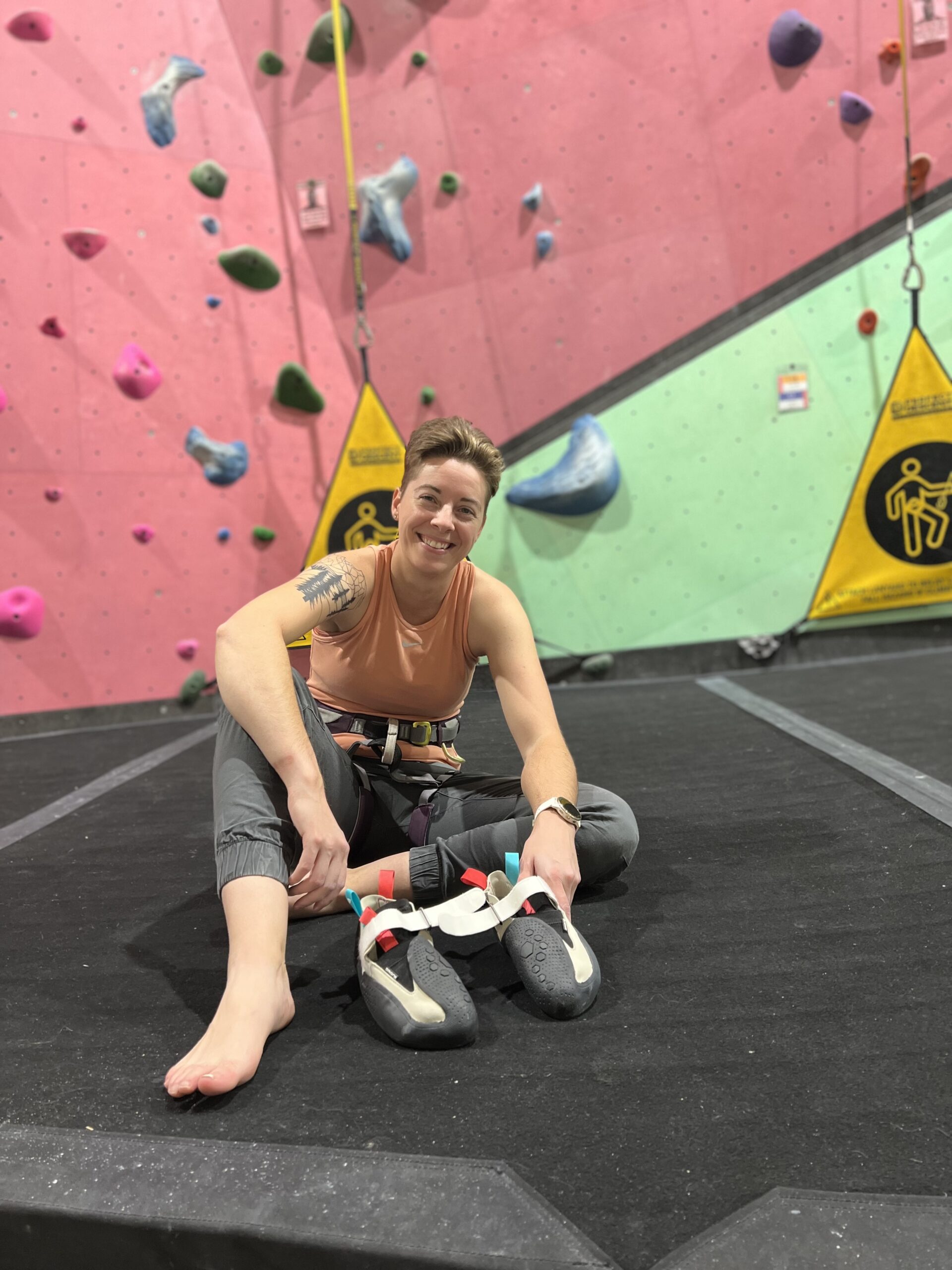
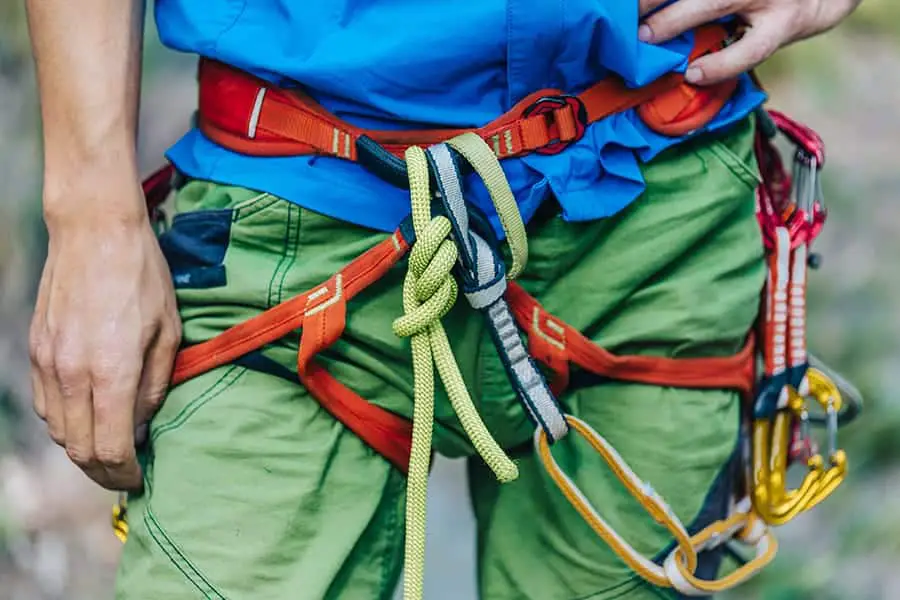
A friend I recently got hooked on climbing told me she was shopping for a new harness and wanted to know how it should fit so she could pick the right size. It’s been years since I bought a harness (I take good care of the one I have), so I did some digging to help her out. If you’re a brand new climber, our beginner’s guide to indoor climbing is a good place to start too.
So how should your climbing harness fit? Your harness should sit above your hip, tight enough that it won’t slide down but loose enough to avoid hot spots or pressure points. The leg loops should be tight enough that you can only fit up to four flat fingers between the loop and your leg, but loose enough for full movement.
With so many brands, hip padding options, and loop setups out there, it can be tough to know what size is best for you. The good news is there are general guidelines, plus brand by brand sizing, that make the call a lot easier.
How Should Your Climbing Harness Fit? Fit Guidelines
There are a few parts of the harness to think about when you’re fitting one to your body and the kind of climbing you do. Here are the general guidelines that will help you land on the right size. Once you have it dialed, check out how to put on a harness so you get it on the same way every time.
Waistband Fitting
- The first step in finding the right size waistband (also known as waist belt) is to identify the circumference of your waist.
- You can use the circumference of your waist to identify what size, depending on the brand that is the best fit for you (see harness sizing table below)
- Put on the harness and place the waistband above your hip
- Tighten the waistband so it’s snug enough to keep from sliding down but loose enough that it doesn’t cause pressure points or hot spots
Leg Loop Fitting
The leg loops aren’t really what keeps you from falling out of your harness. They’re more about comfort and spreading the load so you don’t flip upside down. Because of that, you can run your leg loops as tight as feels good to you.
- Measure your leg circumference
- Ensure that the size of your harness includes your leg circumference in the sizing range (see harness sizing table below)
- Put on the harness and adjust the waistband as needed (see above)
- Tighten the leg loops until you can only fit four fingers between you and the leg loop.
- Ensure that you still have full movement in your legs. If you don’t have full movement, identify if it’s the leg loop tightness or the “rise” straps that are preventing you from moving. If it’s your leg loops, loosen them as needed.
Rise Strap Fitting
Most harnesses have fixed rise straps. Those are the straps at the back that connect the leg loops to the waistband.
If yours are adjustable, you can tune the rise straps as described below. If they’re a fixed length and they don’t work for you, it’s worth trying a different harness with a rise that suits your body better.
- After adjusting your waist and leg loops to the appropriate tightness (see above).
- Move your legs around to see if you have a full range of motion.
- If you have limited range of motion, loosen the rise straps (or find a harness with longer rise straps)
- Test the rise straps while hanging in the harness (many climbing outlets have climbing walls or rope to test hanging in the harness).
- If while hanging in the harness, you have to use core strength to keep your body upright and the harness doesn’t force you into a sitting position, tighten/loosen the rise strap or find a harness with a smaller/bigger rise straps until you find a harness that holds you in a sitting position.
Wear What You Plan To Climb In
To make sure the harness actually fits, try it on with whatever you’ll be wearing when you climb. If you’re ice climbing, put on all the layers you plan to wear out there before you judge the fit.
If you’re climbing in the gym in pants and a t-shirt, test the harness in that. Not sure what to bring? Here’s what to wear indoor rock climbing.
The Hang Test
While you’re hanging in a harness, you shouldn’t be able to fit more than a fist between the waistband and your body. If you can, size down or cinch the waistband tighter.
A lot of climbing shops and outdoor stores have a wall or a rope you can hang on to test a harness before you buy it. Use it if you can.
Hanging is the best way to tell if you’ve got the right fit, the right padding, and whether you can reach all the gear on your loops. If your main use is rappelling, take a look at our guide to harnesses for rappelling before you decide.
Harness Sizing For Different Brands
Every brand sizes its harnesses a little differently, and sizing can even change model to model. So here are the most popular harness brands and their sizing. If you’re still deciding which one to buy, here are my favorite harnesses for climbing.
Here is a harness size chart by brand:
| Size | Waist | Thigh/Leg | Brand | Model |
| XS | 24 to 28 | 18.5 to 20.9 | Mammut, Women | NA |
| XS | 25 to 27 | 20.5 to 22 | ARC’TERYX, Women | NA |
| XS | 25.5 to 27.5 | 21.5 to 23 | ARC’TERYX, Women C-QUENCE | NA |
| XS | 25.6-27.8 | 18.1-22 | Petzl | AQUILA, LUNA, |
| XS | 25.6-27.9 | 18.9-20.9 | Petzl | HIRUNDOS, SELENA |
| XS | 26-29 | 18-20 | Black Diamond, Women | NA |
| XS | 27.5 to 29.5 | 20.5 to 22 | ARC’TERYX, Unisex | NA |
| XS | 28 to 30 | 20.5 to 23 | ARC’TERYX, Men | NA |
| XS | 28 to 30 | 21 to 22 | ARC’TERYX, Men C-QUENCE | NA |
| S | 26.4 to 30.3 | 19.3 to 22.4 | Mammut, Men | NA |
| S | 26.4 to 30.3 | 20 to 22.4 | Mammut, Women | NA |
| S | 26.4-30.3 | 18.9-20.9 | Petzl | SITTA |
| S | 27 to 29 | 21.5 to 23 | ARC’TERYX, Women | NA |
| S | 27-30 | 19-21 | Black Diamond, Men | NA |
| S | 27.5 to 29.5 | 23 to 24 | ARC’TERYX, Women C-QUENCE | |
| S | 27.8-30.3 | 18.9-22.8 | Petzl | SELENA, AQUILA |
| S | 28-30 | 18.5-22.4 | Petzl | ADJAMA |
| S | 28-30.3 | 18.9-20.9 | Petzl | SAMA, HIRUNDOS |
| S | 28-30.3 | 20-24 | Petzl | LUNA, |
| S | 28-31 | 20-22 | Black Diamond, Women | NA |
| S | 29.5 to 32 | 22 to 23.5 | ARC’TERYX, Unisex | NA |
| S | 30 to 32 | 21.5 to 23 | ARC’TERYX, Men | NA |
| S | 30 to 32 | 22 to 23 | ARC’TERYX, Men C-QUENCE | NA |
| S/M | 25.2-33.8 | 21.6-26.4 | Petzl | TOUR |
| S/M | 25.2-33.9 | 21.6-26.4 | Petzl | ALTITUDE |
| M | 28.7 to 33.5 | 20.9 to 24 | Mammut, Men | NA |
| M | 28.7 to 33.5 | 21.7 to 24 | Mammut, Women | NA |
| M | 29 to 32 | 23 to 24.5 | ARC’TERYX, Women | NA |
| M | 29.5 to 31.5 | 24 to 25 | ARC’TERYX, Women C-QUENCE | NA |
| M | 30-33 | 21-23 | Black Diamond, Men | NA |
| M | 30-33 | 20-24 | Petzl | ADJAMA, |
| M | 30.3-33 | 20.5-24.4 | Petzl | AQUILA, SITTA |
| M | 30.3-33 | 20.5-22.5 | Petzl | HIRUNDOS |
| M | 30.3-33 | 21.3-25.2 | Petzl | LUNA |
| M | 30.3-33 | 21.6-23.6 | Petzl | SELENA |
| M | 30.3-33.1 | 20.4-22.5 | Petzl | SAMA |
| M | 32 to 34 | 23 to 24.5 | ARC’TERYX, Men C-QUENCE | NA |
| M | 32 to 34.5 | 23.5 to 25 | ARC’TERYX, Unisex | NA |
| M | 32 to 34.5 | 23 to 24. | ARC’TERYX, Men | NA |
| M | 33-36 | 22-24 | Black Diamond, Women | NA |
| M/L | 29.1-37.8 | 23.6-28.7 | Petzl | ALTITUDE, TOUR |
| L | 30.3-33 | 21.6-23.6 | Petzl | SELENA |
| L | 31.5 to 34.5 | 25 to 26.5 | ARC’TERYX, Women C-QUENCE | NA |
| L | 31.5 to 36.2 | 22.4 to 25.6 | Mammut, Men | NA |
| L | 31.5 to 36.2 | 23.2 to 25.6 | Mammut, Women | NA |
| L | 32.5 to 36 | 24.5 to 26 | ARC’TERYX, Women | NA |
| L | 33-36 | 23-25 | Black Diamond, Men | NA |
| L | 33-36.2 | 21.3-25.2 | Petzl | ADJAMA |
| L | 33-36.2 | 21.6-25.6 | Petzl | AQUILA |
| L | 33-36.2 | 21.6-23.6 | Petzl | HIRUNDOS, SITTA |
| L | 33-36.2 | 22-26 | Petzl | LUNA |
| L | 33.1-36.2 | 21.6-23.6 | Petzl | SAMA |
| L | 34 to 37.5 | 24.5 to 26 | ARC’TERYX, Men C-QUENCE | NA |
| L | 34.5 to 38 | 25 to 26.5 | ARC’TERYX, Unisex | NA |
| L | 35 to 38.5 | 24.5 to 26 | ARC’TERYX, Men | NA |
| L | 36-39 | 24-26 | Black Diamond, Women | NA |
| L/XL | 33-42.5 | 26-31.1 | Petzl | ALTITUDE, TOUR |
| XL | 33.9 to 39.4 | 23.6 to 26.7 | Mammut, Men | NA |
| XL | 34.5 to 38.5 | 26.5 to 29 | ARC’TERYX, Women C-QUENCE | NA |
| XL | 36 to 39.5 | 26.5 to 28 | ARC’TERYX, Women | NA |
| XL | 36-39 | 25-27 | Black Diamond, Men | NA |
| XL | 36.2-39.3 | 22-26 | Petzl | ADJAMA |
| XL | 36.2-39.4 | 22.4-26.4 | Petzl | AQUILA |
| XL | 36.2-39.4 | 22.5-24.4 | Petzl | HIRUNDOS |
| XL | 36.2-43 | 22.4-24.4 | Petzl | SAMA |
| XL | 37.5 to 41 | 26 to 28 | ARC’TERYX, Men C-QUENCE | NA |
| XL | 38 to 41 | 25.5 to 28 | ARC’TERYX, Unisex | NA |
| XL | 39 to 42 | 26.5 to 28 | ARC’TERYX, Men | NA |
| XXL | 33 to 42.5 | 24.4 to 28.3 | Mammut, Men | NA |
Once your gear fits, the fastest way to actually get better is to climb more often and train a little between sessions. If you want short, climbing-specific drills in your inbox, join our free newsletter and level up your climbing with 15 minutes of training each week.
Frequently Asked Questions
How tight should a climbing harness be?
The waistband should sit above your hip and be snug enough that it won’t slide down, but loose enough to avoid hot spots or pressure points. Set the leg loops so you can only fit up to four flat fingers between the loop and your leg while still keeping full movement.
Should a climbing harness sit above or below your hips?
Above your hips. The waistband should ride above your hip bones so it can’t slip off if you end up upside down. If it sits on or below your hips, size down or move it up and re-tighten.
How do I know if my harness is too big?
Do the hang test. While hanging in the harness you shouldn’t be able to fit more than a fist between the waistband and your body. If you can, or if the waistband slides down when you weight it, the harness is too big and you should size down or tighten the waistband.
Do climbing harness sizes differ by brand?
Yes. Each brand, and often each model, uses its own waist and thigh ranges. Measure your waist and leg circumference, then match those numbers to the brand’s sizing (see the size chart above) rather than assuming a medium is a medium everywhere.